
Reasons Not to Move to Kelowna: An Honest Look Before You Relocate

Published Updated 6 min read
On this page
- Kelowna at a glance
- 1. Housing costs are high for a mid-sized city
- 2. The wildfire-smoke season keeps getting longer
- 3. Drought and summer water restrictions
- 4. Highway 97 congestion is a daily fact of life
- 5. A narrow job market and long healthcare waits
- So, should you cross Kelowna off?
- What a long-distance move to Kelowna actually involves
Quick answer: Kelowna is genuinely beautiful, but there are real reasons to move somewhere else. The five biggest are high home prices (the single-family benchmark sits above $1M), a lengthening wildfire-smoke season, summer drought and water restrictions, chronic Highway 97 congestion, and a tourism-weighted job market paired with the longest primary-care wait times in the province. If those trade-offs are dealbreakers, another Okanagan or BC city may suit you better.
Most “reasons not to move to Kelowna” articles are secretly love letters — they list “downsides” like too much wine and too many sunsets. That is not useful if you are actually weighing the decision. This is the honest version: the specific, documented drawbacks a prospective resident should factor in before committing to a long-distance move.
I run MTS Moving as a second-generation long-distance mover and a member of the Canadian Association of Movers. We relocate households into the Okanagan from Ontario, Alberta and the Lower Mainland every season, so the notes below mix public data with what we see on the ground moving families in. Kelowna may still be the right call for you — but go in with eyes open.
Kelowna at a glance
- Kelowna, BC
- British Columbia
- Kelowna, BC
- Central Okanagan
- Kelowna, BC
- ~254,600 (July 2025, Greater Kelowna)
- Kelowna, BC
- ~$1,062,800 CAD (May 2026, Assoc. of Interior Realtors / CREA)
- Kelowna, BC
- ~$732,400 CAD (May 2026)
- Kelowna, BC
- ~$498,200 CAD (May 2026)
- Kelowna, BC
- Tourism, agriculture, healthcare, aerospace, tech
- Kelowna, BC
- Wildfire smoke, summer drought, Highway 97 traffic
1. Housing costs are high for a mid-sized city
Kelowna’s biggest surprise for newcomers is the price of getting in the door. As of May 2026, the MLS Home Price Index single-family benchmark for the Central Okanagan was about $1,062,800 CAD, per the Association of Interior Realtors data published through CREA. Townhomes benchmarked near $732,400 and condos near $498,200.
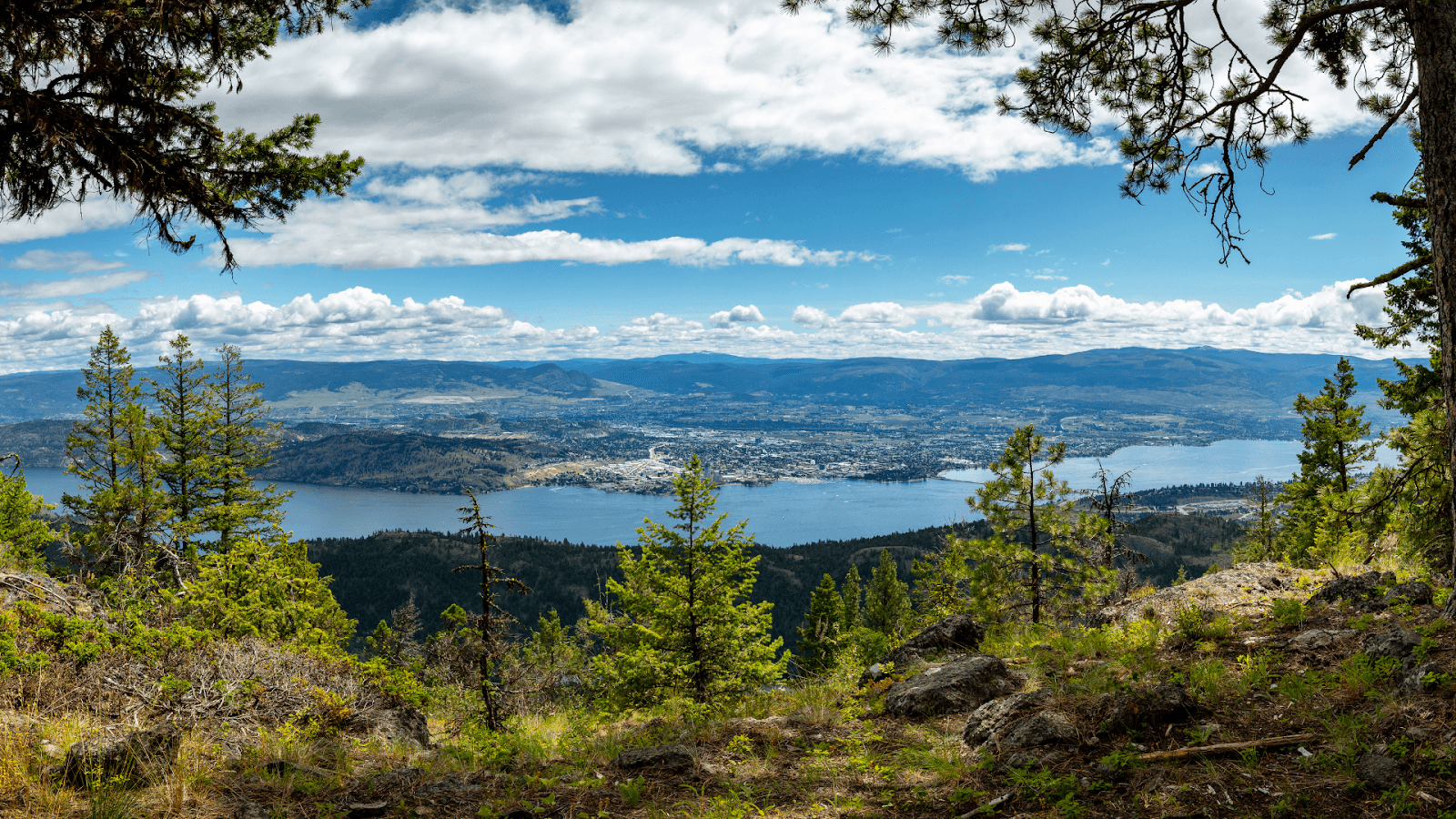
That is below Metro Vancouver, but well above what you would pay for a detached home in most Prairie cities — a benchmark that is often several hundred thousand dollars higher than comparable homes in Calgary or Edmonton. If you are relocating from Alberta expecting a lateral move on housing, budget for a step up. Rents and everyday costs sit in the middle of the BC range rather than the bottom.
2. The wildfire-smoke season keeps getting longer
The Okanagan’s dry, forested setting is beautiful nine months of the year and hazy for part of the summer. The City of Kelowna’s air-quality program tracks how often fine-particulate (PM2.5) levels blow past provincial objectives during fire season — and the trend is not encouraging. In a bad year the region has logged more than 20 days exceeding the PM2.5 objective by mid-August alone, with the valley’s air ranking among the worst in the world on peak smoke days.
For anyone with asthma, a respiratory condition, or young kids, that matters. Smoke days mean cancelled outdoor plans, air purifiers running indoors, and checking the BC Air Quality Health Index before deciding whether to open a window. It is the single downside long-term residents mention most.
3. Drought and summer water restrictions
The same climate that grows the wine grapes also means water is not a given. The Okanagan Basin has been in a multi-year drought, and in 2026 the region entered drought response unusually early, with Okanagan Lake at a record low for the date and below-average snowpack.
Practically, that translates into outdoor watering restrictions most summers. The Regional District of Central Okanagan has moved to Stage 2 restrictions — outdoor watering limited to two days a week, roughly mid-June through mid-September — in recent years. If your dream is a lush lawn and a big vegetable garden, adjust expectations toward drought-tolerant landscaping.
4. Highway 97 congestion is a daily fact of life
Kelowna grew faster than its road network. Highway 97 is the city’s main artery, and the William R. Bennett Bridge over Okanagan Lake is a genuine bottleneck: local reporting and resident campaigns describe crawling traffic across the bridge and 30-minute delays at peak times, a problem that population growth and tourism only compound in summer.
There is no rapid-transit relief valve, so if you picture small-city living without small-city commutes, the reality of crossing town at 5 p.m. in July may disappoint. Where you buy relative to your workplace matters more here than in many cities its size.
5. A narrow job market and long healthcare waits
Kelowna’s economy leans heavily on tourism, agriculture, construction and healthcare, with anchor employers like Interior Health, KF Aerospace, UBC Okanagan and Okanagan College. It is not a deep, diversified job market — outside those sectors and a growing tech scene, professional openings can be thin. The Kelowna CMA unemployment rate was around 7.0% in early 2026, and much of the tourism work is seasonal.

Healthcare access is the harder pill. British Columbia’s family-doctor shortage is real, and the Interior Health region has the longest median attachment wait in the province — around 477 days to be connected to a primary-care provider. If having a family doctor lined up is important to your household, factor that timeline in before you list your current home.
So, should you cross Kelowna off?
Not necessarily. Every city trades something away, and for many people the lake, the wine country and the four-season outdoor lifestyle outweigh smoke season and a tough housing market. The point is to decide with real information rather than a highlight reel. If the pros still win for you, our companion post on whether Kelowna is a good place to live covers the upside in depth, and it is worth reading alongside this one.
If the cons give you pause, nearby options are worth a look. Kamloops offers a drier, more affordable Interior alternative, while Lower Mainland communities like Richmond and Surrey trade valley scenery for job depth and transit.
What a long-distance move to Kelowna actually involves
Whichever way you land, getting your household there is its own project. The two main approaches into the Central Okanagan are over the mountains from Alberta or up from the coast:
- Driving distance to Kelowna
- ~390 km (driving distance)
- Driving distance to Kelowna
- ~600 km (driving distance)
Two things shape our scheduling into Kelowna more than anywhere else we serve in BC:
- Winter mountain passes. The Coquihalla (Highway 5) and the Okanagan Connector (Highway 97C) are high-elevation routes that see winter-storm warnings, heavy snow and periodic closures from late fall into spring. We build weather buffers into winter delivery windows rather than promising a hard arrival time, and we watch DriveBC in the days before a move.
- Wildfire season. In peak summer, road closures and detours tied to active fires can add hours or force a reroute. For July–September moves we keep a flexible plan and stay in contact if conditions shift.
On the ground, a full-service move into the Okanagan covers packing and protecting your belongings, loading, interprovincial transport, and unloading at your new home — with secure storage or storage-in-transit if your possession dates do not line up, which is common when you are buying into a tight market from out of province. As a CAM member with a 4.9-star rating from 741 Google reviews, we plan the route and timing around the passes so your goods arrive safely rather than on an optimistic guess.
If Kelowna still makes your list, our long-distance movers to Kelowna page lays out the routes, timing, and pricing. You can get a free, no-obligation estimate for your specific origin, home size and dates through our plan-your-move quote.
Related guides

The newcomer’s guide to long-distance moving to Vancouver
What a long-distance move to Vancouver really costs — corridor price ranges, cost of living, neighbourhoods, transit and moving-day tips from a mover.
Learn more
Is Kelowna a good place to live? The full newcomer’s guide
Moving to Kelowna? A mover's honest guide to 2026 cost of living, neighbourhoods, jobs, transit and lake lifestyle — plus the trade-offs to plan for.
Learn more
What is Kamloops known for?
From outdoor adventure to affordable living, discover what Kamloops is known for — plus real moving-corridor advice for relocating there.
Learn more
Moving to Richmond, BC
Moving to Richmond, B.C.? Real 2025 housing and rent numbers vs Vancouver, best neighbourhoods, transit, schools and long-distance move tips from MTS.
Learn more
Moving to Surrey
Moving to Surrey, BC? A long-distance mover breaks down 2026 home prices, rent, neighbourhoods, commutes and the real downsides before you relocate.
Learn more
Director, MTS Moving
Mete Kalfa is the Director of MTS Moving and a second-generation long-distance relocation expert. Specializing in inter-provincial moves across Ontario, Alberta, and British Columbia, he leverages decades of family legacy and active Canadian Association of Movers (CAM) membership to provide transparent insights that protect consumers from industry scams.