
Packaging Materials for a Long-Distance Move: A Mover's Guide

Published Updated 7 min read
On this page
- What packaging materials do you need for a long-distance move?
- Which items break most often without the right supplies?
- How big is a wardrobe box?
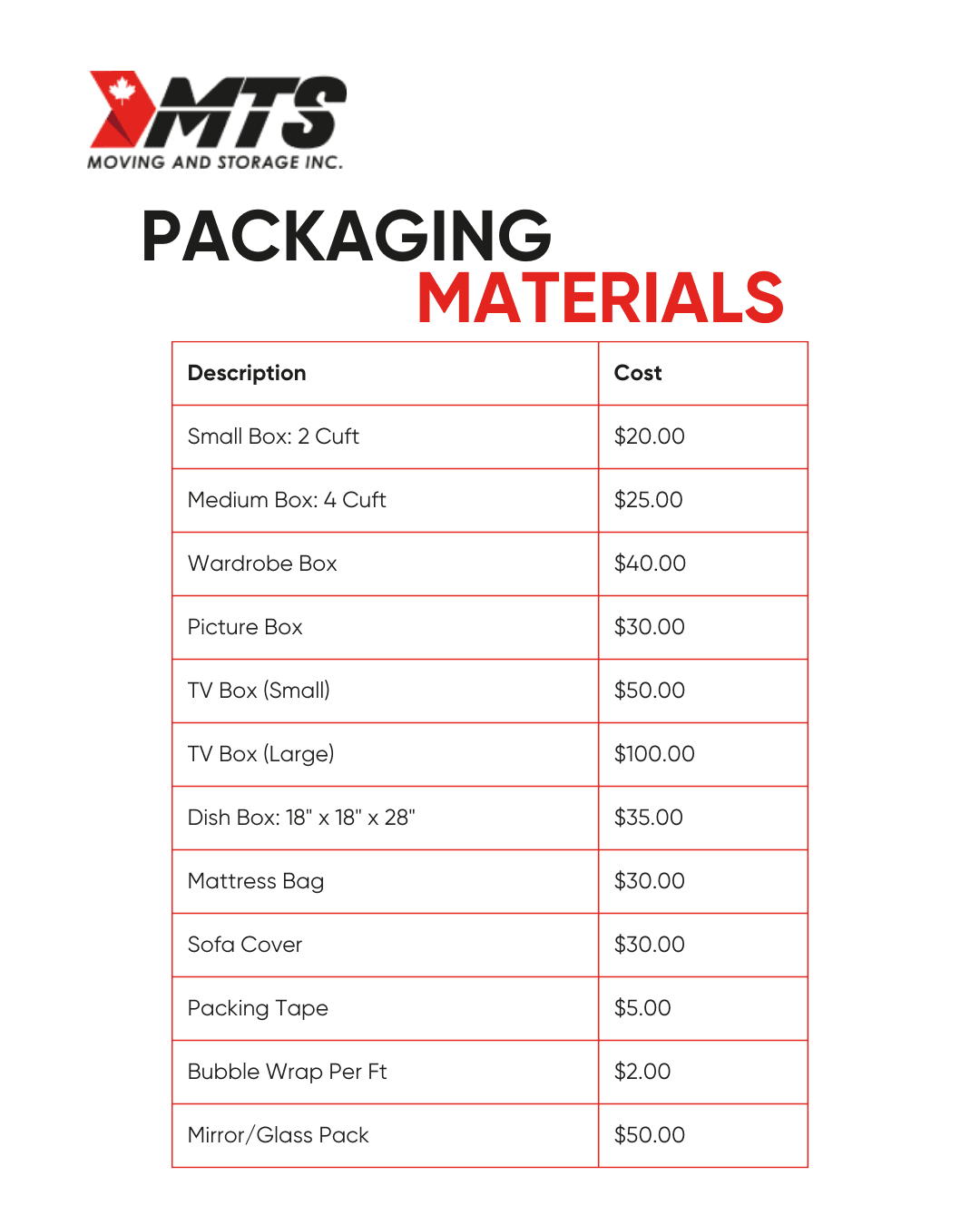
- How much do moving supplies cost in Canada?
- Should you buy boxes, reuse them, or rent plastic bins?
- Why good materials protect your move — and your money
- Frequently asked questions
- What is the difference between a dish pack and a regular box?
- Do I really need specialty boxes for a long-distance move?
- How many boxes do I need?
Quick answer: For a long-distance move, use sturdy double-walled boxes, quality packing tape, bubble wrap and packing paper, furniture blankets, and specialty boxes (dish packs, wardrobe boxes, mirror/glass packs) for fragile or awkward items. On a cross-province haul your belongings are stacked, re-handled at transfer points, and exposed to days of vibration, so proper supplies protect them far better than reused or flimsy ones.
I am Mete Kalfa, director of MTS Moving & Storage, a second-generation long-distance mover based in Mississauga, Ontario, and a member of the Canadian Association of Movers (CAM). On a local move a box only has to survive one lift into a van and one lift out. On an interprovincial move — Vancouver to Toronto, or Calgary to Montreal — the same box is loaded, driven for days, sometimes held in storage-in-transit, re-handled at a transfer point, and unloaded. That is a completely different structural demand, and it is why the materials you choose matter so much more over long distances.
This guide covers materials and supplies only. For how to pack efficiently, see our packing hacks for moving; for the order to pack rooms in, see what to pack first when moving.
What packaging materials do you need for a long-distance move?
The materials below cover the vast majority of household items. As a rough planning guide, a one-bedroom home usually needs around 15–30 boxes, a two-bedroom 30–50, and a three-bedroom 50–80, plus the specialty boxes, wraps, and covers listed here. Dimensions are given in inches with approximate centimetre equivalents.
- Approx. size
- 16 x 12 x 12 in (≈41 x 30 x 30 cm)
- Best for
- Books, DVDs, tools, canned goods and other heavy or fragile items packed in small quantities; the compact size keeps contents from shifting in transit
- Approx. size
- 18 x 18 x 16 in (≈46 x 46 x 41 cm)
- Best for
- Kitchenware, toys, small appliances and clothing; balanced loads that are easy to carry and stack
- Approx. size
- 24 x 24 x 40 in (≈61 x 61 x 102 cm)
- Best for
- Hanging garments such as dresses, coats and suits; a built-in metal hanger bar keeps clothes organized and wrinkle-free
- Approx. size
- Telescoping / adjustable
- Best for
- Framed artwork and mirrors; the telescoping structure fits snugly around various frame sizes to prevent movement
- Approx. size
- Various sizes
- Best for
- Flat-screen TVs; padded with foam inserts or paired with bubble wrap, with a sturdy corrugated exterior to prevent scratches
- Approx. size
- Double-walled, with cell dividers
- Best for
- Plates, bowls and glasses; the extra cushioning and dividers keep each piece separated and reduce breakage
- Approx. size
- Twin / full / queen / king
- Best for
- Protecting a mattress from water, dirt and dust in transit or storage
- Approx. size
- Large plastic sheet
- Best for
- Shielding sofas from moisture, dust, dirt and snags when loaded onto the truck
- Approx. size
- At least 2 in (≈5 cm) wide
- Best for
- Sealing and binding boxes; choose thicker, stronger tape for the heaviest boxes
- Approx. size
- Sold by the foot
- Best for
- Cushioning electronics, collectibles, glassware and other delicate valuables
- Approx. size
- Corrugated sleeves + foam pockets
- Best for
- Mirrors and glass tabletops; envelops edges and surfaces to prevent cracks or breaks
Which items break most often without the right supplies?
The items that suffer most on long hauls are dishes and glassware packed in ordinary single-walled boxes. The Canadian Association of Movers recommends a “stronger walled container called a barrel or dish pack” for these items specifically, and gives the same routine our crews follow: pack plates on edge rather than flat, put “at least three pieces of paper between each dish,” and stand stemware and glasses upright in the box, never laid down (CAM, Safe Packing).
A few practical rules that come up on almost every long-distance job:
- Pack the heaviest items (books, canned goods) in small boxes only, so no single box becomes too heavy to handle safely — aim to keep each box under about 50 lb (23 kg).
- Load boxes heaviest on the bottom, lightest on top, and fill every void with packing paper so nothing shifts over hundreds of kilometres. A box that rattles when you shake it will rattle for the whole trip.
- Wrap framed art and mirrors in a picture box or mirror/glass pack — these are the items most often damaged when packed flat among other boxes.
- Label boxes on two sides (not the top, which disappears when boxes are stacked) with the room and a short description, per CAM’s guidance, and mark fragile boxes clearly.
- For winter relocations, keep electronics and candles out of an unheated truck overnight where you can, and let cold items reach room temperature before unpacking.
How big is a wardrobe box?
A standard wardrobe box measures roughly 24 x 24 x 40 inches (about 61 x 61 x 102 centimetres) and works like a portable closet, with a built-in metal hanger bar so clothes travel on their hangers and arrive wrinkle-free.
How much do moving supplies cost in Canada?
Prices vary by retailer and region, but the ranges below give a realistic budget. New cardboard boxes typically run about $1–$8 each depending on size and wall strength; at U-Haul Canada, for example, a large box works out to roughly $2.48 each in a 15-pack, and a grand wardrobe box is around $16.95 (U-Haul, Moving Boxes).
- Typical Canadian price (new)
- ≈ $1.50 – $4 each
- Typical Canadian price (new)
- ≈ $12 – $20 each
- Typical Canadian price (new)
- ≈ $10 – $18 each
- Typical Canadian price (new)
- ≈ $3 – $6 per roll
- Typical Canadian price (new)
- ≈ $20 – $35
- Typical Canadian price (new)
- ≈ $0.30 – $1
- Typical Canadian price (new)
- ≈ $5 – $15
Multiplying box counts by these figures, expect a rough supply budget in the range of $80–$150 for a one-bedroom, $150–$300 for a two-bedroom, and $300–$500 for a three-bedroom move once tape, paper, and a few specialty boxes are added. Buying box kits or having your mover supply materials as part of a packing service is often cheaper per item than buying piecemeal.
Should you buy boxes, reuse them, or rent plastic bins?
You do not need brand-new everything. Here is where each option genuinely works — and where it fails on a long haul:
- Reused cardboard is fine for light, non-fragile, low-value items — linens, pillows, soft toys, out-of-season clothing — as long as the box is clean, dry, and still square with intact flaps. Grocery and liquor-store boxes are handy here.
- Reused cardboard fails for anything heavy or fragile. Boxes that have already been through one move, been stored damp, or lost their rigidity crush under a week of stacking. Mismatched sizes also stack poorly and leave gaps that let loads shift. Dishes, books, and electronics belong in new, correctly-sized cartons.
- Rental plastic bins are worth considering for local or short-distance moves and for anyone who wants to avoid cardboard waste. In Canada, rental services typically charge around $1.50–$5 per bin per week, or roughly $115–$325 per week for a home-sized bundle depending on the number of bins (MovingWaldo). The catch on interprovincial moves is logistics: bins have to be returned to the same city, which rarely fits a one-way cross-country relocation. For those, cardboard you keep or recycle at the destination is usually the practical choice.
Why good materials protect your move — and your money
The materials you pack in are not just about convenience; they directly affect what you can recover if something is damaged. Under Canadian provincial conditions of carriage, a mover’s basic “released value” liability is limited to $0.60 per pound ($1.32 per kg) per article — included at no charge but minimal (CAM, Liability). A 100 lb item destroyed in transit settles at $60 under that basic coverage regardless of what it cost to replace, which is why CAM recommends buying replacement-value protection and declaring items of extraordinary value such as artwork.
Two things follow for how you pack. First, sound materials and technique are your real first line of defence — insurance is a backstop, not a substitute for a dish pack. Second, on many claims the standard of packing matters: owner-packed boxes that fail can be harder to claim on than professionally packed ones, so if a box holds anything valuable or fragile, either pack it properly in the right carton or let a crew pack it.
Frequently asked questions
What is the difference between a dish pack and a regular box?
A dish pack is double-walled corrugated cardboard, usually with cell dividers, built to absorb impact and keep each plate or glass separated. A regular single-walled box has neither the wall strength nor the internal structure to protect breakables over a long, vibrating haul.
Do I really need specialty boxes for a long-distance move?
For most soft goods, no — sturdy standard boxes are enough. But for dishes, framed art, mirrors, TVs, and hanging clothes, specialty boxes (dish packs, mirror/glass packs, TV boxes, wardrobe boxes) prevent the breakages and creases that standard boxes cannot, and they pay for themselves the first time they save an item.
How many boxes do I need?
As a planning guide: roughly 15–30 boxes for a one-bedroom, 30–50 for a two-bedroom, and 50–80 for a three-bedroom home, plus specialty boxes. It is worth buying slightly more than you think — running out mid-pack is more disruptive than a few leftover boxes.
MTS Moving & Storage handles packing, secure storage, and interprovincial transport across Ontario, Alberta, British Columbia, and Quebec, and we are rated 4.9 stars from 741 Google reviews. If you would rather hand the fragile boxes and the supply run to a crew, that is what we are here for.
Related guides

What to pack first and last when moving
A long-distance mover's room-by-room order for what to pack first and last, plus a first-night box list that keeps essentials within reach on arrival.
Learn more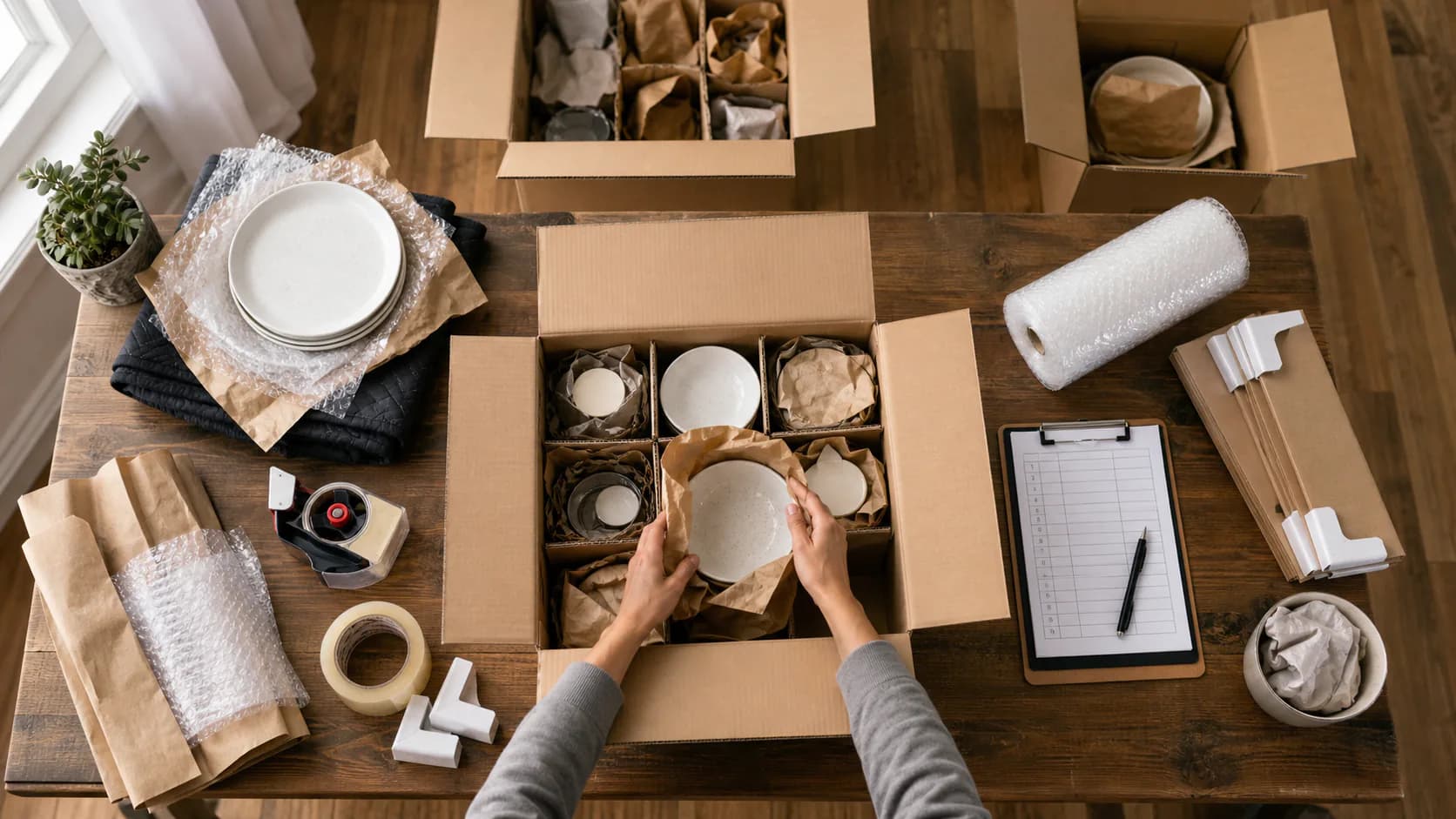
Packing hacks for moving
Packing hacks from long-distance movers: weight caps, fragile-proofing for highway transit, a labelling system that survives handoffs, and the trade-offs.
Learn more
Choosing the right storage for your move
How to choose the right storage for a move: unit size, climate control, monthly costs in Canada, and when storage-in-transit beats renting a locker.
Learn more
Moving large furniture across the country
How to move heavy, bulky furniture across Canada: measuring, disassembly, wrapping, real insurance limits, and when to hire pros. From MTS Moving crews.
Learn more
Director, MTS Moving
Mete Kalfa is the Director of MTS Moving and a second-generation long-distance relocation expert. Specializing in inter-provincial moves across Ontario, Alberta, and British Columbia, he leverages decades of family legacy and active Canadian Association of Movers (CAM) membership to provide transparent insights that protect consumers from industry scams.