
How to Avoid Hidden Fees on a Long-Distance Move in Canada

Published Updated 7 min read
On this page
Quick answer: Hidden moving fees almost always trace back to a vague quote that leaves out weight-based pricing and “accessorial” charges: fuel surcharges, long carries, stairs, shuttle trucks, bulky-item handling and packing labour. Avoid them by getting a written estimate that lists every possible charge, sending photos and measurements up front, confirming what is included, and (in Ontario) knowing your mover legally cannot exceed the estimate by more than 10% without your approval.
I’m Mete Kalfa, director at MTS Moving and a second-generation long-distance mover based in Mississauga. In two decades of cross-province moves, I’ve learned that customers rarely get burned by the base price. They get burned by the line items nobody explained before moving day. This guide walks through exactly what those charges are, what they typically cost in 2025-2026, and how to keep them off your invoice.
How long-distance movers actually price a move
For an interprovincial move, the number that drives everything is the weight of your shipment, not the number of boxes and not the hours worked. That is the single most important thing to understand, because most “hidden fee” surprises are really weight surprises.
Here is how the weight is established, and why it is legitimate when done correctly:
- The truck is weighed empty at a government-certified scale (the “tare” weight).
- Your goods are loaded and the truck is weighed again (the “gross” weight).
- The difference is your shipment weight, and you should receive the weigh-scale tickets for both weigh-ins.
You are entitled to see those tickets. The Canadian Association of Movers (CAM) — of which MTS is a member — advises that when a quote is weight-based, you should clarify how the final weight is determined and confirm you’ll receive a weight ticket. If a mover can’t produce scale tickets, that is a red flag, not a rounding error.
On top of the weight-based transport charge (the “linehaul”), long-distance quotes carry a distance component — often quoted at roughly $0.20 to $0.50 per kilometre depending on truck size and crew — plus the accessorial charges covered below. For full context on how these pieces add up across a coast-to-coast move, see our long-distance moving costs guide for Canada.
What hidden moving fees actually cost
None of the charges below are illegitimate. They become “hidden” only when a mover leaves them off the quote. There is no reliable Canada-wide price for these services: each company sets its own written rates, and the actual work varies by property. The useful comparison is whether the charge applies, how it is calculated and whether it is included in your signed estimate.
- What triggers it
- Applied to the linehaul, sometimes adjusted as diesel prices move
- How it is commonly calculated
- Percentage or fixed amount defined in the quote
- How to keep it off your invoice
- Ask for it as a line item in the written quote, not “added later”
- What triggers it
- Truck can’t park close to your door
- How it is commonly calculated
- Distance bands defined by the mover
- How to keep it off your invoice
- Measure the walk from likely parking to your entrance and tell the mover
- What triggers it
- Flights of stairs with no elevator
- How it is commonly calculated
- Per flight or included allowance
- How to keep it off your invoice
- Confirm the stair/elevator policy in writing (MTS includes one floor up/down free)
- What triggers it
- Booking a building’s service elevator
- How it is commonly calculated
- Fixed fee or included service
- How to keep it off your invoice
- Ask whether the mover charges for elevators at all (MTS does not)
- What triggers it
- A large trailer can’t reach the address, so a smaller truck relays the load
- How it is commonly calculated
- Labour, vehicle and transfer time
- How to keep it off your invoice
- Have the mover verify truck access at both ends before booking
- What triggers it
- Piano, safe, pool table, canoe
- How it is commonly calculated
- Per item, based on weight and handling needs
- How to keep it off your invoice
- List every special item on the inventory in advance
- What triggers it
- Crew packs for you
- How it is commonly calculated
- Hourly, varies
- How to keep it off your invoice
- Get the hourly rate in writing (MTS includes the first hour free)
- What triggers it
- Wrapping fragile, textile or electronic items
- How it is commonly calculated
- Per item / per box
- How to keep it off your invoice
- Ask which items require paid wrapping versus free wrapping
A note on that fuel surcharge line, because it is the one customers most often overlook: some movers build fuel into the linehaul, while others show it as a separate percentage or fixed amount. On a large cross-country load the difference can be material, so pin down the exact calculation and whether it can change after signing before you book.
A worked example: why the estimate is not the final price
The most common misconception I hear is that the quoted number is a fixed price. On a weight-based move it is not — it is an estimate that settles against the actual scale weight. A quick worked example shows why getting the weight right matters more than anything else.
Say a mover estimates your three-bedroom home at 8,000 lbs. On moving day the certified scale reads 9,500 lbs, because the estimate missed a full garage and a shed. That extra 1,500 lbs gets billed at the same weight-based rate as the rest of the load — and it also raises the fuel surcharge, since that surcharge is a percentage of the transport charge. Nothing improper happened; the estimate was simply built on the wrong weight.
This is also why the $0.60-per-pound basic liability matters. Under released-value protection — the coverage included in every Canadian move by default — a mover’s liability is limited to $0.60 per pound per article. As CAM’s own example puts it, a 100-lb table destroyed in transit settles at $60, even if it cost $1,000 to replace. If you’re moving anything valuable, that is the number that tells you to buy replacement-value coverage instead.
The lesson is not “distrust the estimate.” It is “make the estimate accurate.” Send a complete inventory, flag the garage and the storage room, and you remove the single biggest source of a surprise final bill.
The one move that keeps every fee visible: get it in writing
Almost everything above collapses into one habit. Before you book, get a written estimate that lists every potential charge, and give the mover enough information that nothing can be “discovered” later.
- Provide a full inventory and measurements. Weight drives the price, so an accurate list drives an accurate quote. Overstate box counts rather than understate them.
- Send photos and video. Show the crew the narrow driveway, the third-floor walk-up, the piano, the long walk from the street. Visual evidence is what lets a mover quote a shuttle or long carry now instead of billing it on the day.
- Ask for the full list of possible charges up front. CAM’s guidance is blunt on this: a written estimate is your protection against being scammed. Get every accessorial in the contract before you sign.
- Confirm the mover owns its trucks and crews. Direct operators service the same corridors repeatedly and quote them accurately; booking brokers hand your load to a third party and lose that accountability. Our checklist for vetting cross-province movers covers what to ask.
Your rights if a bill comes in over the estimate
If you’re moving within or out of Ontario, you have a hard legal backstop. Under the province’s consumer-protection rules, a mover cannot charge more than 10% above the estimate in your contract unless you agreed to additional supplies or services. Other provinces have their own conditions of carriage, but the written contract is the anchor everywhere.
Two practical points from that same Ontario guidance:
- A mover cannot hold your goods hostage to pressure you into paying more than the contract terms.
- If you’re forced to pay a disputed charge to get your belongings released, write “paid under protest” on the invoice, document what happened, and then pursue a complaint. That preserves your right to dispute it.
This is exactly why a detailed written estimate is worth the extra hour up front. It turns a “he-said-she-said” over a surprise fee into a document you can enforce.
What to look for in a transparent mover
A quote that itemizes fuel, carries, stairs and special items isn’t padding your bill — it’s a sign the company has moved your kind of load before and isn’t hiding the real cost to win the booking. When you compare movers, weight three things:
- A written, itemized estimate you can hold them to.
- Regular routes to your destination, so your goods aren’t handed to a third party mid-move.
- Verifiable reputation. MTS holds a 4.9-star rating from 741 Google reviews and is listed on Yelp, HomeStars and the BBB (Mississauga), and we serve corridors across Ontario, Alberta, British Columbia and Quebec.
Get three written quotes, compare the accessorial lines side by side, and pick the mover whose number you understand — not just the lowest one. For the deeper vetting checklist, our guides on avoiding long-distance moving scams and the mistakes that inflate a move go further.
Related guides

Understanding long-distance moving costs in Canada
What it costs to move across Canada in 2026, by home size and by route (Toronto–Calgary, Toronto–Vancouver), plus the hidden fees to check before you book.
Learn more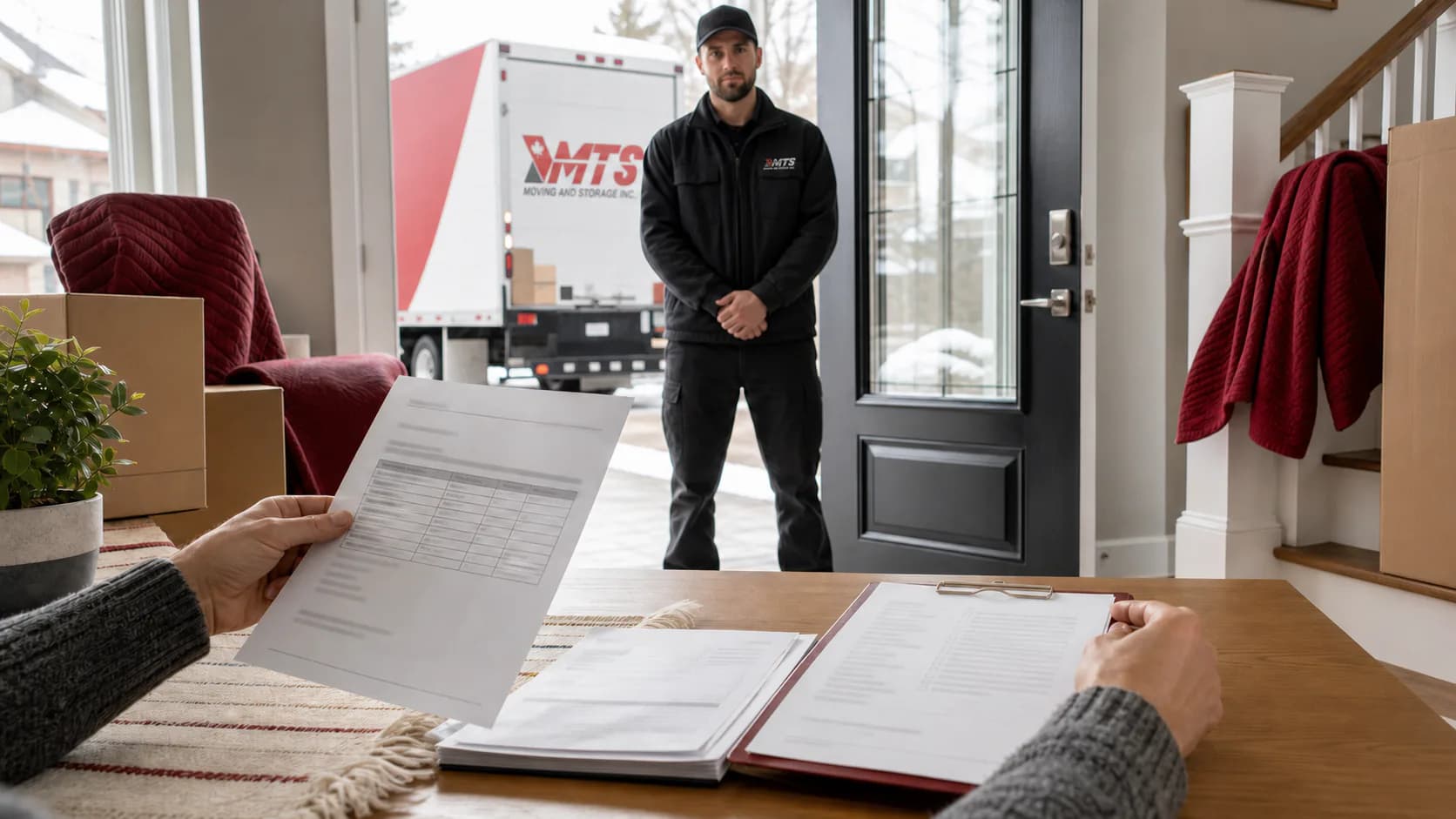
What to look for in cross-province movers
How to vet cross-province movers: the credentials, coverage, and contract terms that separate legitimate interprovincial carriers from rogue operators.
Learn more
How to avoid long-distance moving scams in Canada
How to spot and avoid long-distance moving scams in Canada: the 7 most common cons, the red flags, and the CAM- and government-backed checks that protect you.
Learn more
Long-distance moving mistakes to avoid
The 5 costliest long-distance moving mistakes Canadians make — and how a second-generation mover avoids them. Real coverage rules, costs, and fixes.
Learn more
How to choose the best long-distance movers
How to choose the best long-distance movers in Canada — CAM membership, written quotes, full-value protection and the scam red flags to check before you book.
Learn more
Director, MTS Moving
Mete Kalfa is the Director of MTS Moving and a second-generation long-distance relocation expert. Specializing in inter-provincial moves across Ontario, Alberta, and British Columbia, he leverages decades of family legacy and active Canadian Association of Movers (CAM) membership to provide transparent insights that protect consumers from industry scams.