
Moving from Toronto to Montreal: Cost, the 401 Drive & July 1

Published Updated 8 min read
On this page
- What does it cost to move from Toronto to Montreal?
- Dedicated truck vs. shared-load
- The 401 drive: distance, timing, and winter risk
- July 1 Moving Day: plan around it or pay for it
- Getting into Montreal homes: walk-ups and Old Montreal access
- Quebec paperwork and the language factor
- Is it cheaper to live in Montreal than Toronto?
- Job market: opportunities and work culture
- Choosing a Montreal neighbourhood
Quick answer: A professional move from Toronto to Montreal typically costs about CAD 1,600–4,600 for a one- to three-bedroom home, covers 544 km (a 5–6 hour drive down Highway 401), and lands in a lower-rent, bilingual city. The single biggest thing to plan around is Quebec’s July 1 Moving Day, when nearly the whole province changes apartments at once and truck availability and prices spike.
I’m Mete Kalfa, Director of MTS Moving & Storage and a second-generation long-distance mover based in Mississauga. Toronto–Montreal is one of the corridors our crews run most, so this guide covers both halves of the decision: what the move itself actually involves, and how the two cities compare once you’re settled. Where a number appears, it’s sourced; where a claim would need a fabricated price or story, I’ve left it out.
What does it cost to move from Toronto to Montreal?
For most households, a full-service interprovincial move between Toronto and Montreal runs roughly CAD 1,600 to 4,600, according to route-cost aggregator MoveAdvisor. A studio or lightly-loaded one-bedroom can come in under that; a large three- or four-bedroom home with packing, storage, or specialty items runs above it. The variables that move the number are, in order of impact:
- Volume and weight — the single largest driver. A four-bedroom home can cost several times what a one-bedroom does.
- Season and date. Summer is peak, and (as below) the July 1 window in Quebec is the most expensive week of the year.
- Add-on services — full packing/unpacking, appliance disconnection, secure storage or storage-in-transit, white-glove handling, junk removal.
- Access at both ends — stairs, no elevator, long carries, and street-parking permits (a real factor in central Montreal — see below).
Dedicated truck vs. shared-load
On a corridor this busy, you have two ways to ship:
- Dedicated truck
- Your shipment fills a truck that goes door to door
- Shared / consolidated load
- Your goods travel with other Toronto–Montreal shipments on the same trailer
- Dedicated truck
- Higher
- Shared / consolidated load
- Lower — typically 10–20% less
- Dedicated truck
- Tight, often next-day
- Shared / consolidated load
- Wider (a range of days)
- Dedicated truck
- Larger homes, firm dates, fragile/high-value loads
- Shared / consolidated load
- Smaller loads, flexible dates, tighter budgets
Because Toronto–Montreal is a high-frequency route, shared-load slots are usually easy to fill both directions, which is what makes the savings reliable rather than theoretical. If your dates are flexible, ask any mover you shortlist to quote both options. For a broader breakdown of what drives an interprovincial bill, see our guide to long-distance moving costs in Canada.
The 401 drive: distance, timing, and winter risk
Toronto and Montreal sit 544 km apart — about a 5-to-6-hour drive straight down Highway 401, which becomes Autoroute 20 at the Quebec line (Tourisme Montréal). For a loaded moving truck making a legally-required rest stop, plan closer to a full day door to door.
A few things we watch on this run:
- Winter is the real risk, not the distance. The 401 through eastern Ontario and the stretch into Quebec gets lake-effect snow, freezing rain, and sudden whiteouts from November through March. A same-day delivery promise in January is a promise about the weather, not the truck — build a buffer day into your plan and don’t schedule utility hook-ups or elevator bookings so tightly that one storm cascades into a week.
- It’s a single-day corridor in good conditions. Outside winter, most of our Toronto–Montreal jobs load one day and deliver the next, which keeps shared-load windows short.
- Rush hours at both ends. Leaving the GTA and arriving into Montreal both bottleneck 7–9 a.m. and 4–6 p.m.; delivery timing is planned around them.
July 1 Moving Day: plan around it or pay for it
This is the most important date on the Quebec moving calendar, and most people relocating from Ontario have never heard of it. Historically, Quebec residential leases have run July 1 to June 30, so on July 1 a huge share of the province changes homes on the same day — the Montreal Gazette has long estimated well over 100,000 people moving in the city alone (Wikipedia: Moving Day (Quebec)). It coincides with Canada Day, so almost everyone has the day off to do it.
What that means for your move:
- Prices peak and trucks vanish. Demand around July 1 spikes far above a normal week, and it’s the single hardest date of the year to book any mover in Quebec. If your move must land in that window, book well in advance and expect premium pricing.
- Book off-peak if you can. Even shifting to mid-June or mid-July materially improves both availability and price.
- The tradition is softening but not gone. Recent reporting notes fewer people moving strictly on July 1, partly due to evictions and repossessions (CBC News) — but it’s still the peak, and the surrounding week is still congested.
Getting into Montreal homes: walk-ups and Old Montreal access
Montreal’s housing stock is genuinely different from Toronto’s, and it changes how a move actually gets carried in. Two realities our crews plan for on nearly every downtown-area job:
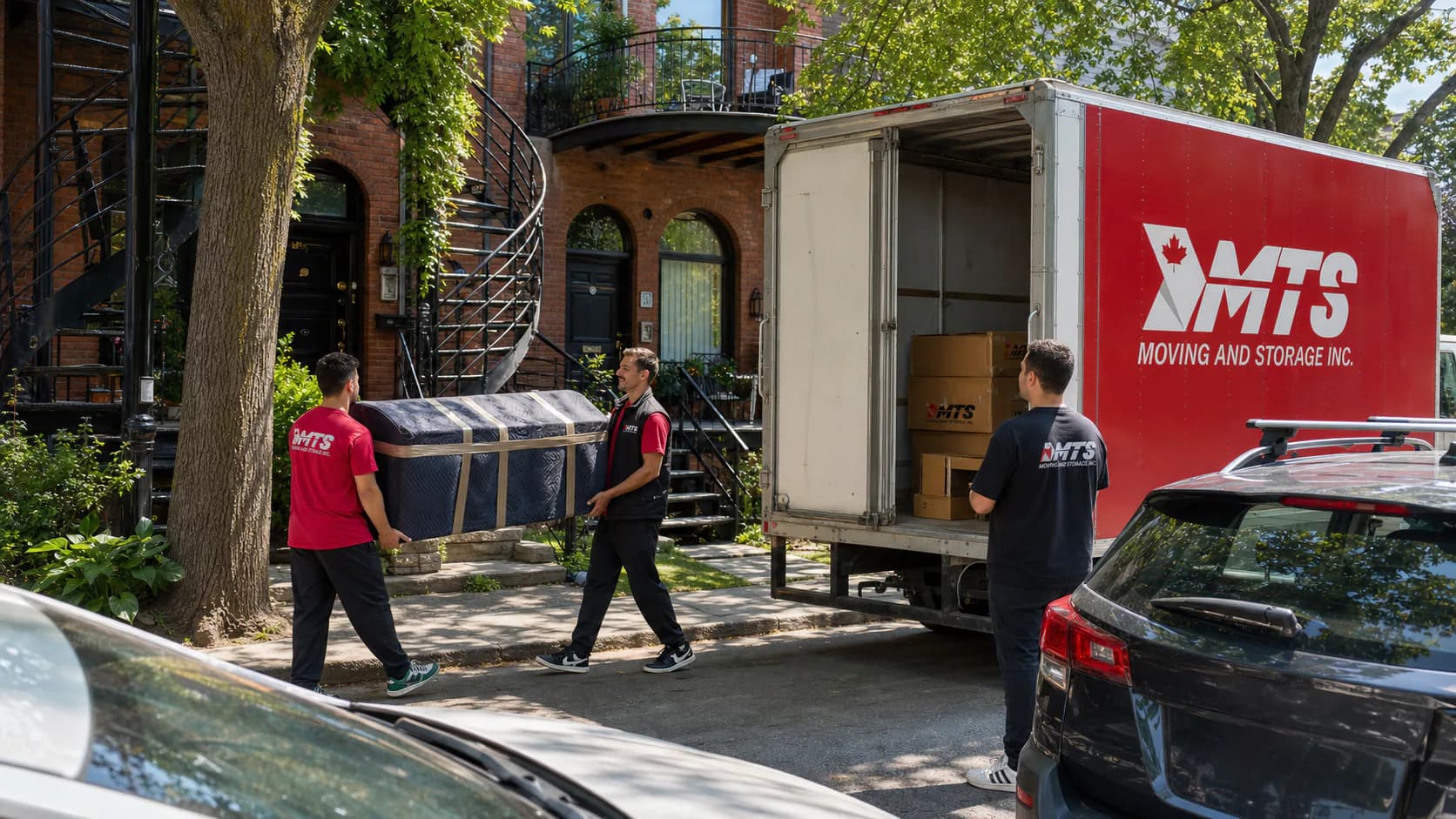
- Plateau Mont-Royal and Mile End walk-ups. Much of the classic Montreal housing is two- and three-storey flats with no elevator and the city’s signature narrow, curved outdoor staircases. They’re beautiful and they’re a real constraint: large sofas, mattresses, and appliances often can’t take the stairs and have to be hoisted or disassembled. If you’re eyeing a Plateau walk-up, tell your mover the floor and the staircase type before quoting — it’s the difference between a two-person and a four-person carry.
- Old Montreal and dense central streets. Narrow one-ways, limited loading zones, and permit-only parking mean the truck often can’t sit at the door. Montreal issues temporary parking/occupancy permits for moves through the borough offices; arranging one ahead of time avoids a long carry or a ticket.
Ask any mover how they handle no-elevator walk-ups and central-Montreal parking. A crew that runs the corridor will have a straight answer; one that doesn’t is a flag — the same due diligence we cover in what to look for in cross-province movers.
Quebec paperwork and the language factor
You don’t need French to move, but Quebec’s language law (Bill 96 / Law 14) shapes daily life once you arrive. Businesses operating in Quebec must serve customers in French, and while newcomers can access some services in another language, that accommodation is time-limited (CFIB overview of Law 14). Practically:
- Expect leases, utility set-up, driver’s licence and health-card (RAMQ) paperwork, and municipal services to default to French.
- Basic French smooths the transition and, as below, widens your job options — but Montreal is highly bilingual and you can absolutely settle in while you learn.
- For the move itself, keep a clear written inventory and confirm your mover’s cargo protection/valuation coverage in writing before load day; an interprovincial move crosses a jurisdiction line, so the contract, not a verbal quote, is what governs.
Is it cheaper to live in Montreal than Toronto?
Yes — on the biggest line items, clearly. Here’s how the recurring monthly costs compare:
- Toronto
- ~CAD 2,250
- Montreal
- ~CAD 1,740
- Toronto
- CAD 156 (TTC)
- Montreal
- CAD 110.00 (STM)
Rent: Toronto’s average one-bedroom was CAD 2,246 in Q1 2026 (TRREB rental market report); Montreal’s averaged CAD 1,739 (Rentals.ca, April 2026) — roughly CAD 500/month less. Buying is cheaper in Montreal too. Transit: the STM’s Tous modes A monthly pass rose to CAD 110.00 on July 1, 2026 (STM fares); the TTC adult monthly pass is CAD 156 (the TTC moves to monthly fare capping September 1, 2026).
Utilities and groceries also tend to run a little lower in Montreal, though the gap there is far smaller than on rent.
Job market: opportunities and work culture
Montreal’s economy leans on aerospace, video games and tech, and healthcare; Toronto is the national finance and media hub with higher average salaries and a more competitive, faster-paced work culture. On the jobs picture itself, the old “Montreal has worse unemployment” assumption no longer holds: in May 2026 the two were essentially level — Toronto 6.8%, Montréal 6.5% (Statistics Canada, Labour Force Survey, May 2026).
The practical differentiator is language. Functional French meaningfully widens your options across most Montreal employers, even in bilingual workplaces. To browse openings before you move, Job Bank Canada filters by city and language requirement.
Choosing a Montreal neighbourhood
Rather than a generic “explore the community” checklist, here’s the shortlist we hear most from families and professionals relocating from Toronto:
- Plateau Mont-Royal / Mile End — walkable, café-dense, and iconic, but classic walk-ups (mind the staircases above). Central and lively; best if you don’t need a car or an elevator.
- Villeray / Rosemont — a little further out, calmer, strong value on rent, popular with families; good metro access.
- Old Montreal / Griffintown — downtown-adjacent condos with the tightest move-in access and parking constraints.
- Verdun / NDG (Notre-Dame-de-Grâce) — quieter, more space for the money, family-friendly, and among the more anglophone-comfortable areas.
Whichever you pick, confirm two things before you sign: whether there’s an elevator, and what the street parking/loading situation is. Both directly affect move-in day.
Related guides

Moving between Alberta and Ontario: the corridor guide
Moving from Alberta to Ontario or back? Costs by home size, 4–8 day delivery windows, and the health card, licence and tax changes to handle on arrival.
Learn more
Long-distance moving costs in Canada
What it costs to move across Canada in 2026, by home size and by route (Toronto–Calgary, Toronto–Vancouver), plus the hidden fees to check before you book.
Learn more
Long-distance moving to Toronto: the complete guide
Moving to Toronto from another province? An interprovincial mover's guide to costs, condo elevator rules, downtown access, and planning your move.
Learn more
What to look for in cross-province movers
How to vet cross-province movers: the credentials, coverage, and contract terms that separate legitimate interprovincial carriers from rogue operators.
Learn more
Best cities to move to long distance in Canada
Calgary, Ottawa, Hamilton, Halifax or Winnipeg? Compare 2026 home prices, jobs and the delivery-day realities from a long-distance mover who runs the routes.
Learn more
Director, MTS Moving
Mete Kalfa is the Director of MTS Moving and a second-generation long-distance relocation expert. Specializing in inter-provincial moves across Ontario, Alberta, and British Columbia, he leverages decades of family legacy and active Canadian Association of Movers (CAM) membership to provide transparent insights that protect consumers from industry scams.