
Winter Long Distance Moving Guide: How to Prepare for a Safe and Efficient Move

Published Updated 7 min read
On this page
- Is winter a cheaper time to move long distance?
- Winter hazards by corridor
- How should you plan a winter interprovincial move?
- How do professional movers weatherproof a load in winter?
- How can you and the crew stay safe on the road in winter?
- Moving during the holiday season
- Preparing your new home before the truck arrives
Quick answer: A winter long-distance move is the cheapest time of year to relocate in Canada — off-season rates run roughly 10-30% below summer — as long as you plan for the weather. Stay flexible with dates, book a mover experienced on your corridor, weatherproof the load against moisture and deep freeze, check provincial 511/DriveBC route status before travel, and have heat and utilities on before you arrive.
Updated for the 2025-2026 winter season.
I’m Mete Kalfa, Director at MTS Moving & Storage. I’m a second-generation long-distance mover based in Mississauga, and our crews run interprovincial corridors across Ontario, Alberta, British Columbia, and Quebec through the winter every year. Most people assume winter is the worst time to move. In our experience it’s often the smartest — you just have to move like someone who’s done it in a whiteout before.
Below is the same guidance we give our own winter customers: what it actually costs, how we protect a load in the cold, and how we drive the routes safely.
Is winter a cheaper time to move long distance?
Yes — and this is the trade-off most people miss. Demand for movers collapses between late fall and early spring, so rates drop to fill the calendar. Industry data puts off-season moves (roughly October through April) at about 10-30% below peak-season pricing, and a single flexible booking can swing a mid-size interprovincial quote by several hundred dollars.
You also get the parts of the service that money can’t always buy in July: your pick of crews, more flexible loading dates, and a truck that isn’t already half-full of someone else’s month-end move. For a detailed breakdown by home size and distance, see our guide to long-distance moving costs in Canada.
The cost you’re weighing against is weather risk — delays, closures, and cold-sensitive items. The rest of this guide is about neutralizing that risk so the savings are worth it.
Winter hazards by corridor
Winter risk varies enormously by route, so know what you’re booking into before you commit to a date. The table below summarizes the typical winter hazards on the corridors we run.
- Typical winter hazard
- Snow, avalanche control closures, mandatory chain-ups
- What it means for your move
- Winter tires legally required; build in schedule flexibility for pass closures
- Typical winter hazard
- Lake-effect snow squalls, sudden deep freezes
- What it means for your move
- Whiteout-driven highway slowdowns on short notice
- Typical winter hazard
- Extreme deep freeze, ground blizzards
- What it means for your move
- Protect temperature-sensitive items; expect wind-driven visibility drops
- Typical winter hazard
- Heavy snowfall, storm systems
- What it means for your move
- Arrange snow removal at the destination before the truck arrives
How should you plan a winter interprovincial move?
Stay flexible with your dates. A single storm can shut a mountain pass or a prairie highway for a day or more, and no reputable mover will run a crew into a closure. Give yourself a delivery window rather than a single fixed date. Winter is off-season, so flexibility is easier to get and cheaper than in summer.
Hire a mover who is accountable, not just cheap. The cheapest winter quote is often an unlicensed operator with no insurance and nowhere to escalate a complaint. Look for a member of the Canadian Association of Movers (CAM) — CAM has represented Canadian movers since 1969 and requires members to carry a minimum of $1 million in liability and $250,000 in cargo coverage, sign a code of ethics, and submit to a formal consumer-complaint process. MTS is a CAM member, and we also hold a 4.9-star rating from 741 Google reviews plus listings on Yelp, HomeStars, and BBB (Mississauga).
Talk through the contingency plan before you book. Ask specifically: what happens if a pass closes mid-transit, who calls you, and how the delivery window shifts. A crew that has run your corridor in January will have a clear answer.
Pack a winter go-bag you keep with you. Warm layers, blankets, medications, phone chargers, and a day of non-perishable food travel in the car with you — never in the truck. If travel stalls overnight, you have what you need on hand.
How do professional movers weatherproof a load in winter?
This is where experience shows. Cold itself rarely breaks furniture — moisture, condensation, and temperature shock do. Here’s how our crews handle it:
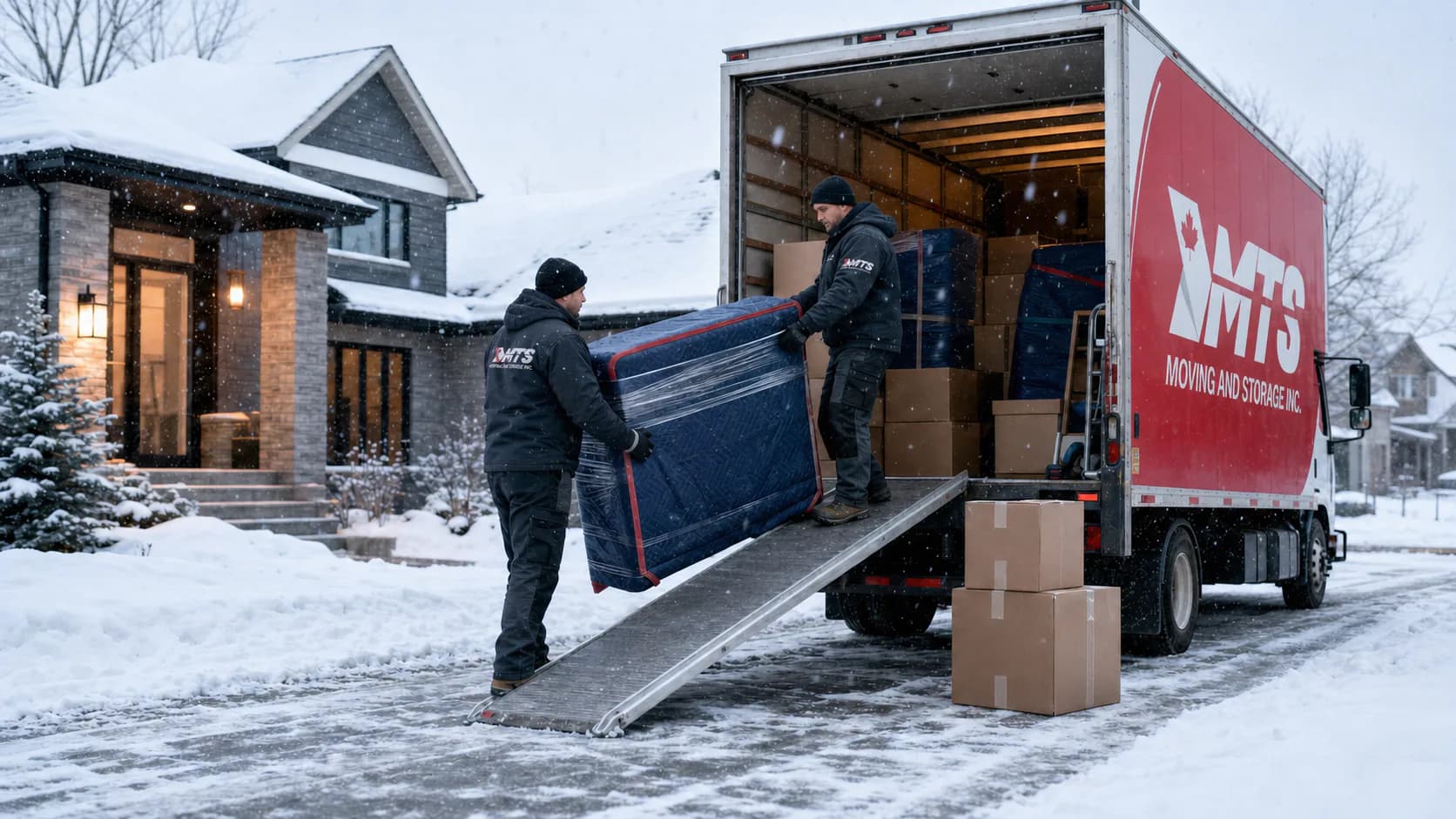
- Blanket-wrap first, plastic second. We pad-wrap furniture in moving blankets, then shrink-wrap over the blanket. Shrink-wrap straight onto a cold surface traps condensation against the finish; the blanket layer absorbs it.
- Moisture barriers under cardboard. Boxes never sit directly on a wet or snowy truck floor or driveway. A slushy load line is how cardboard softens and crushes in transit.
- Electronics and screens double-boxed and acclimated. LCD and LED panels have a cold operating limit around 0°C and a storage floor near -20°C; below that, liquid crystals and layers can separate. The bigger risk is powering a frozen TV too soon — we tell customers to let electronics reach room temperature for several hours before plugging anything in, so condensation doesn’t fry a cold board.
- Fast, clear load lanes. The less time a piece spends exposed at the doorway in a deep freeze, the better. We clear and salt a lane before loading starts rather than fighting ice piece by piece.
Consider climate-controlled or storage-in-transit for the fragile things. Musical instruments, antiques, wine, candles, and some electronics don’t like sustained sub-zero cold or a hard thaw. If your dates don’t line up cleanly, our secure storage and storage-in-transit options keep those items in a stable environment instead of a cold truck or an unheated garage.
How can you and the crew stay safe on the road in winter?
Winter tires and chains are the law on many routes — not a suggestion. In British Columbia, winter tires or chains are mandatory on most highways from October 1 to April 30, with fines for non-compliance and drivers turned away at chain-up points. If you’re driving your own vehicle alongside the move, make sure it’s legal for the corridor.
Check route status the morning of travel — every province has a free tool. Use DriveBC for mountain passes and avalanche closures, 511 Alberta (or dial 511) for prairie highways, and Ontario 511 for snow-squall zones. These are updated through the day in winter and will tell you about a closure before you drive into it.
Carry a vehicle emergency kit. Flashlight, first-aid kit, blankets, extra food and water, a shovel, and a phone battery pack. Cell coverage disappears on the remote stretches between provinces.
Drive for the conditions, not the speed limit. Reduce speed, increase following distance, and assume black ice on bridges and shaded curves. This matters most on unfamiliar roads in a province you don’t know yet.
Moving during the holiday season
Relocating over the holidays adds complexity on top of the weather. Book early — the good crews and travel arrangements fill up fast in December, even in the off-season. Watch for closures — utilities, government offices, and building management often run reduced hours or shut entirely around the holidays, which can stall a hand-off. Build that into your timeline, and once you’ve landed, use local holiday markets and events as an easy way to meet the neighbours.
Preparing your new home before the truck arrives
- Get heat and utilities on first. Confirm the furnace works and the power is connected before delivery day. Arriving to an unheated house in a prairie or Atlantic winter turns a smooth move into an emergency.
- Clear and salt access. Snow and ice on the walkway and driveway at the destination is the single most common cause of slips and dropped items on delivery day. If you can’t be there ahead of the truck, arrange snow removal — essential in heavy-snowfall regions like Newfoundland or the Quebec interior.
- Stock a few days of essentials. Food, water, and medications on hand cover you if weather delays the truck or a follow-up store run.
Handle these three and a winter delivery goes exactly like a summer one — just with the off-season price tag.
Related guides

When is the best time to move long distance?
The best time to move long distance in Canada is fall or winter, mid-week and mid-month, when mover rates drop 20-30%. Season-by-season guide from MTS.
Learn more
Fall moving tips
Fall moving tips from a Canadian long-distance mover: off-peak savings, first-snow timing by corridor, packing for multi-day transit, and how to book right.
Learn more
Spring long-distance moves
Planning a spring long-distance move in Canada? See how spring load bans, weather and off-peak rates affect your interprovincial move — and how to plan.
Learn more
Summer long-distance moving tips
A Canadian mover's summer moving guide: what peak season really costs, how to protect heat-sensitive items in an un-cooled trailer, and how to stay safe.
Learn more
Director, MTS Moving
Mete Kalfa is the Director of MTS Moving and a second-generation long-distance relocation expert. Specializing in inter-provincial moves across Ontario, Alberta, and British Columbia, he leverages decades of family legacy and active Canadian Association of Movers (CAM) membership to provide transparent insights that protect consumers from industry scams.