
Best Long-Distance Movers in Canada: How to Choose (and Avoid Scams)

Published Updated 8 min read
On this page
- What actually separates the best long-distance movers?
- Is the company a Canadian Association of Movers (CAM) member?
- How was your estimate built?
- Full-value vs released-value protection: the coverage most people get wrong
- Red flags and moving scams to watch for
- Questions to ask before you book
- What a real cross-province move looks like
- When a self-move might be cheaper
- Where MTS fits
Quick answer: The best long-distance movers in Canada share four things you can actually verify before you book: membership in the Canadian Association of Movers (CAM), a written, itemized estimate built from a real inventory, full-value (not just released-value) protection, and no demand for a large deposit up front. Because there is no licence required to operate as a mover in Canada, those checks — not marketing superlatives — are what separate a professional from a rogue operator.
I’m Mete Kalfa, Director of MTS Moving. I’m a second-generation long-distance mover, we’re a CAM member based in Mississauga, Ontario, and I’ve spent most of my working life loading and routing cross-province shipments. So instead of giving you ten reasons to hire us, this guide gives you the criteria my own family uses to judge a moving company — the same questions you should put to us and to everyone else you’re comparing.
What actually separates the best long-distance movers?
“Best” is a commercial search, and the honest answer is that it depends on your route, your budget, and your tolerance for risk. But every reputable long-distance mover clears the same bar:
- They’re a member of a recognized industry body (in Canada, that’s CAM).
- They give you a written, itemized estimate built from a video or in-home survey of your inventory.
- They offer, and explain, full-value protection — not just the minimum coverage baked into every contract.
- They collect payment on or near delivery, not a large sum up front.
- They put a real person on the phone who can walk your inventory and answer route-specific questions.
Everything below is how to check each of these. The company that passes all five is a safe bet, whether or not it’s us.
Is the company a Canadian Association of Movers (CAM) member?
This is the single most useful filter in the Canadian market. There is no federal or provincial licence you need to call yourself a mover, which is exactly why a voluntary standard matters. CAM vets its members, holds them to a code of conduct covering estimates and contracts, requires a minimum level of cargo liability insurance, and runs a formal complaint process you can escalate to if something goes wrong. With a non-member, that avenue simply doesn’t exist.
CAM also publishes ongoing consumer alerts naming problem operators — worth a two-minute read before you sign anything. Ask any mover for their CAM membership and confirm it on CAM’s own site rather than taking a logo on a website at face value. We’re a CAM member and also listed on Yelp, HomeStars, and the Better Business Bureau in Mississauga; cross-checking a company across independent platforms tells you far more than any single star rating.
How was your estimate built?
Long-distance pricing is usually weight- and distance-based, so an estimate is only as good as the inventory behind it. Before you compare headline numbers, find out how each mover arrived at theirs.
- Inventory-based estimate
- A video or in-home survey of everything that’s moving
- Phone or verbal guess
- A room count or a quick description over the phone
- Inventory-based estimate
- Weight, distance, fuel, coverage, stairs/elevator and taxes, itemized
- Phone or verbal guess
- A single headline number
- Inventory-based estimate
- Settles against the certified scale weight; a complete inventory keeps the two close
- Phone or verbal guess
- Often rises on delivery day once the real weight is on the scale
Whoever you’re comparing, ask how the final bill is calculated, what can change it, and whether the weight is verified on a certified scale with tickets you can see. The one thing to refuse outright is a “verbal quote, we’ll write it up on moving day” arrangement — that’s a classic setup for a price hike once your goods are on the truck.
For a full breakdown of what drives a cross-province price, see our pillar guide on long-distance moving costs in Canada, and read how to avoid hidden fees before you compare quotes side by side.
Full-value vs released-value protection: the coverage most people get wrong
This is the detail that costs families the most and gets explained the least. Every Canadian moving contract includes basic released-value protection at no extra charge — and it’s far weaker than most people assume.
- Released value (default)
- Included
- Full/replacement value protection
- Extra, worth it on high-value shipments
- Released value (default)
- $0.60 per lb ($1.32/kg) per article
- Full/replacement value protection
- Repair, replace, or cash-settle at today’s market price
- Released value (default)
- A 100-lb table destroyed in transit pays out ~$60
- Full/replacement value protection
- The same table is repaired or replaced at its actual value
Those figures come straight from CAM’s valuation guidance. Under released value, a damaged 100-lb table nets you about $60 even if it cost $1,000 to replace. CAM itself recommends replacement-value protection because released value “provides only minimal coverage.” The best movers raise this with you unprompted and put your chosen coverage in writing; a mover who never mentions it is one to be cautious of.
Red flags and moving scams to watch for
Canada has a persistent “rogue mover” problem — the Competition Bureau and a 2022 CBC Marketplace investigation both documented crews that low-ball a quote, load your belongings, then demand far more before they’ll unload. Watch for:
- A large deposit demanded up front. Legitimate movers collect on delivery or take a small deposit with the balance due at delivery. A request for most or all of the cost before your goods move is the biggest single warning sign.
- A quote that’s dramatically cheaper than everyone else, especially from an ad on Kijiji or Craigslist with “no hidden fees” but no fixed address.
- Refusal to put anything in writing, or pressure to sign the contract on moving day.
- No in-home or video survey before a “firm” price — an honest quote needs to see what it’s pricing.
- No CAM membership and no traceable review history across independent platforms.
We cover this in depth in avoiding long-distance moving scams in Canada — required reading if a quote seems too good to be true.
Questions to ask before you book
Copy this list and put it to every company you shortlist, including us:
- Are you a current CAM member, and what’s your registered business name and address?
- How is the final bill calculated, and can I have the estimate in writing?
- What valuation coverage is included, and what does full-value protection cost for my shipment?
- What deposit do you require, and when is the balance due?
- Who physically handles my goods — your own crew or a subcontractor?
- What’s the realistic delivery window for my route, and what happens if you miss it?
A confident, specific answer to all six is what “best” actually looks like. Our fuller checklist lives in what to look for in cross-province movers.
What a real cross-province move looks like
Distance is the reason these moves need a different playbook than a local one. Toronto to Calgary is about 3,412 km, Toronto to Edmonton roughly 3,473 km, and Toronto to Vancouver around 4,381 km. On drives like these, a shipment is on the road for several days, which is why load quality, protection, and a realistic delivery window matter far more than they do across town.
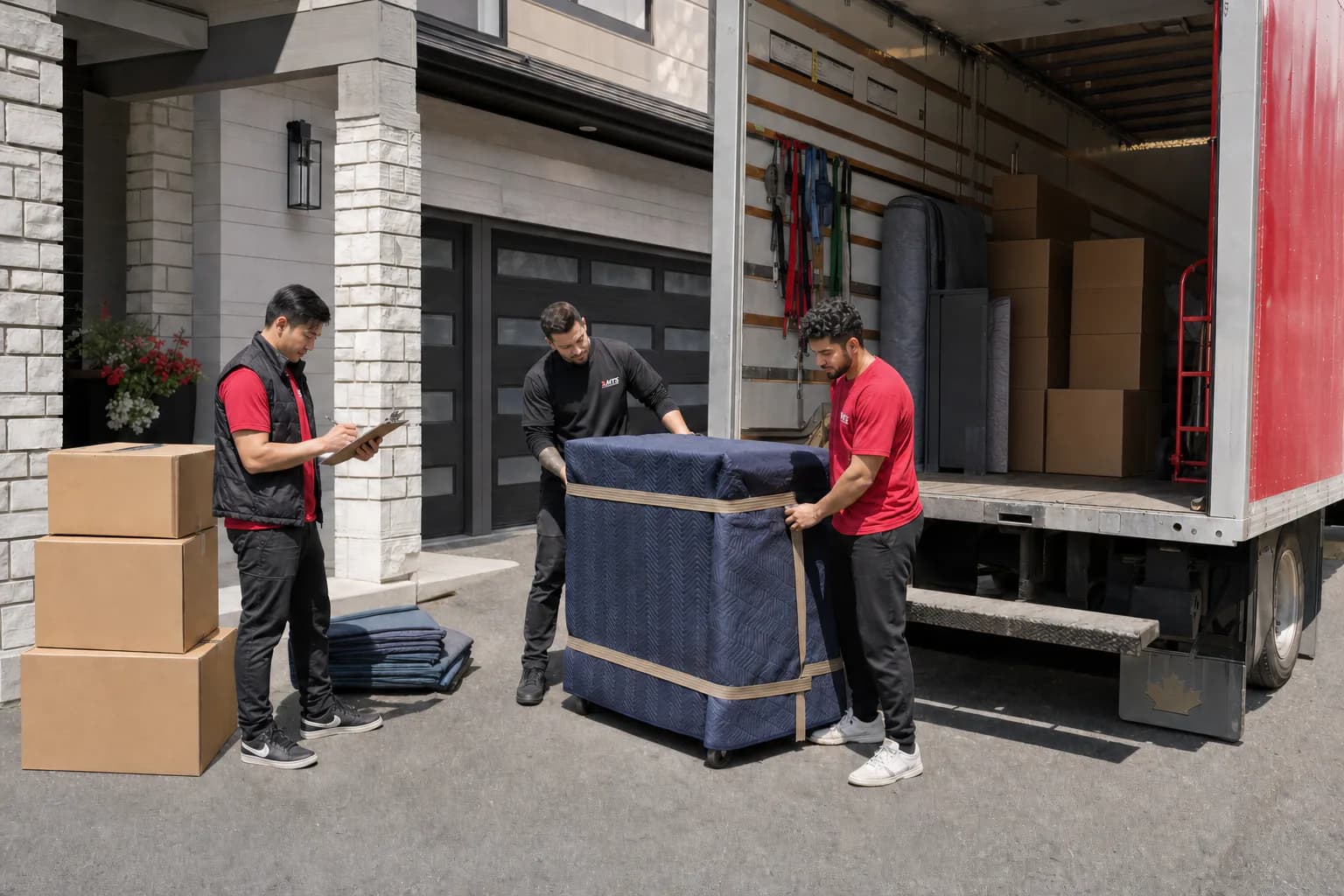
On a typical interprovincial job, our crews inventory and pad-wrap furniture, box and label by room, and blanket- and shrink-wrap the fragile and bulky pieces before anything goes on the truck — because everything gets handled far more on a multi-day haul than on a local move. For families who need to fly ahead of their belongings, we also hold goods in secure storage-in-transit until the destination home is ready.
For destination-specific detail, see our guides for Edmonton, Calgary, Vancouver, and Toronto. As a Canadian long distance moving company, we run interprovincial moving corridors across Ontario, Alberta, British Columbia, and Quebec.
When a self-move might be cheaper
Hiring the best mover isn’t always the right call, and any honest operator will tell you so. If you’re moving a studio or one-bedroom, you’re flexible on timing, and you have help to load and drive, a DIY truck rental can genuinely come in lower than full service — the trade-off is that you carry the labour, the driving days, and all the risk yourself. We break down that math in moving yourself long distance in Canada. Full-service movers earn their price on larger homes, tight timelines, valuable or fragile inventories, and routes where you’d rather not spend four days behind the wheel of a rental. Knowing which camp you’re in is the first real decision — everything in this guide comes after it. And whichever way you go, sidestep the common long-distance moving mistakes that inflate the bill.
Where MTS fits
We’re not the cheapest quote you’ll get, and we won’t pretend to be. What we offer is what this whole guide argues for: CAM membership, written, itemized quotes, full-value protection explained up front, our own trained crews rather than subcontractors, and secure storage when your timelines don’t line up. That’s reflected in a 4.9-star rating from 741 Google reviews, and in our listings on Yelp, HomeStars, and the BBB. Run us through the six questions above alongside anyone else you’re considering — that comparison is the point.
Related guides

Long-distance moving costs in Canada
What it costs to move across Canada in 2026, by home size and by route (Toronto–Calgary, Toronto–Vancouver), plus the hidden fees to check before you book.
Learn more
What to look for in cross-province movers
How to vet cross-province movers: the credentials, coverage, and contract terms that separate legitimate interprovincial carriers from rogue operators.
Learn more
How to avoid hidden fees when moving
Long carry, shuttle, stair and fuel charges quietly inflate a move. Here is what each one costs and exactly how to keep them out of your final invoice.
Learn more
Avoiding long-distance moving scams in Canada
How to spot and avoid long-distance moving scams in Canada: the 7 most common cons, the red flags, and the CAM- and government-backed checks that protect you.
Learn more
Long-distance moving mistakes to avoid
The 5 costliest long-distance moving mistakes Canadians make — and how a second-generation mover avoids them. Real coverage rules, costs, and fixes.
Learn more
Director, MTS Moving
Mete Kalfa is the Director of MTS Moving and a second-generation long-distance relocation expert. Specializing in inter-provincial moves across Ontario, Alberta, and British Columbia, he leverages decades of family legacy and active Canadian Association of Movers (CAM) membership to provide transparent insights that protect consumers from industry scams.