
Exploring Your New Neighbourhood: A Mover's Settling-In Guide

Published Updated 6 min read
On this page
- What should I do in my first week after a long-distance move?
- Transfer your provincial health coverage right away
- Update your driver's licence and vehicle registration
- Clear the rest of the admin list
- How do I get my bearings in a new neighbourhood?
- Where do I find the local knowledge that isn't on a map?
- How do I make friends after moving to a new city?
- Split the move so you can actually settle in
Quick answer: Settle into a new neighbourhood by clearing the time-sensitive admin first — transfer your provincial health coverage, update your driver’s licence, and set up utilities within the first week or two — then explore on foot to map your groceries, pharmacy, transit, and green space. The paperwork has hard deadlines; the exploring is what turns strange streets into home.
I’m Mete Kalfa, director of MTS Moving and a second-generation long-distance mover based in Mississauga. Our crews unload trucks in Ontario, Alberta, British Columbia, and Quebec every week, so we see the same thing on the far end of every long haul: the box-carrying is over in a day, but the settling-in stretches across weeks. The families who land softest are the ones who split the job in two — the admin that has a deadline, and the exploring that doesn’t. This guide keeps them separate on purpose.
What should I do in my first week after a long-distance move?
This is the part people underestimate. When you cross a provincial border, several clocks start the day you arrive, and a few of them run short. Handle these before you go looking for the best coffee on the block — the coffee will still be there next week; the licence deadline won’t.
Transfer your provincial health coverage right away
Interprovincial moves almost always come with a health-coverage waiting period, and it is longer than most people expect. In practice you keep your old province’s card during the gap and register in the new province immediately so the clock starts on day one.
- British Columbia (MSP): coverage begins after a wait of the balance of the month you arrive plus two full calendar months — arrive August 25 and you are covered November 1 (Province of B.C.).
- Alberta (AHCIP): coverage takes effect the first day of the third month after you establish residency, and you must apply within three months of arriving (Alberta.ca).
- Ontario (OHIP): register with ServiceOntario as soon as you arrive; a waiting period can apply before coverage begins.
Because the gap can run close to three months, keep private interim coverage in mind if anyone in the household has ongoing prescriptions or appointments.
Update your driver’s licence and vehicle registration
New residents get a grace window to exchange an out-of-province licence, but the window is finite and worth diarizing:
- British Columbia: you have 90 days to switch your licence after moving to B.C.; if you’re already a B.C. resident and just change address, it’s 10 days (ICBC).
- Alberta: an address change on your licence must be done in person at a registry within 14 days of the change (Alberta.ca).
- Ontario: you must update the address on your driver’s licence within six days of moving (ServiceOntario).
Find your nearest ServiceOntario, Service BC, or Alberta registry office and go early — several of these changes can’t be done online.
Clear the rest of the admin list
- Change your address with Canada Post mail forwarding, your bank, the CRA, your employer, and any insurance or subscriptions.
- Set up utilities — confirm hydro, gas, water, internet, and waste/recycling are in your name, and learn your municipality’s pickup schedule.
- Get on a family-doctor roster or locate the nearest walk-in clinic and pharmacy; rosters have waitlists in many communities, so start day one.
- Register the kids for school with the local board and arrange records transfers and busing.
How do I get my bearings in a new neighbourhood?
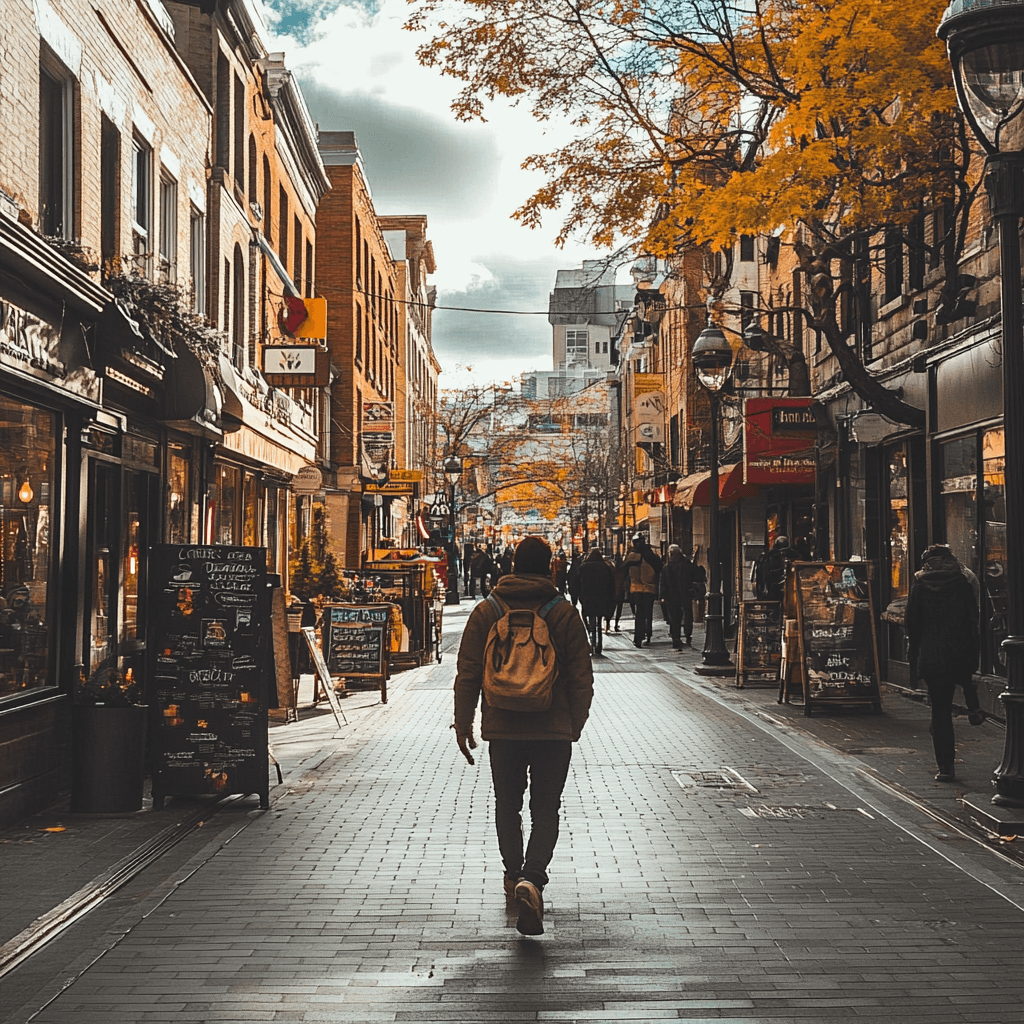
Once the paperwork is moving, the neighbourhood is the fun part — and the fastest way to feel oriented is to walk it, not drive it. From what our crews see on delivery day, the households that settle quickest do a version of the same thing in the first weekend: they walk a widening loop from the front door and map the handful of places they’ll actually use.
Scout these first, roughly in the order you’ll need them:
- What to find
- Nearest grocery store and pharmacy
- Why it matters early
- You’ll need both within days, before the fridge and the medicine cabinet run dry
- What to find
- Transit stop or your commute route
- Why it matters early
- Test it once before your first real workday, not on the morning of
- What to find
- Green space, rec centre, or library
- Why it matters early
- Free, indoors-or-out, and the fastest place to run into neighbours
- What to find
- A local cafe or two
- Why it matters early
- Low-stakes way to become a regular and start recognizing faces
A practical detail from the field: if you arrive in the depths of a Canadian winter, front-load the indoor anchors — the library, the community centre, and municipal recreation programs. Patios and farmers’ markets are months away, and those indoor rooms are where a January arrival actually meets people.
Where do I find the local knowledge that isn’t on a map?
Every neighbourhood has a layer of information that Google Maps won’t show you — which back street floods in spring, which rink has open skate, which grocer stocks what. Two sources cover most of it:
- The neighbourhood Facebook group and the local “Buy Nothing” group. Nearly every Canadian community has both. The Facebook group is where you ask “who’s a good plumber here” and get five honest answers; the Buy Nothing group is where you pick up the shelf, the snow shovel, or the kids’ skates you didn’t want to pay to ship across the country.
- Your municipality’s own website. Recreation registration, waste-collection calendars, snow-route rules, and library programming all live there, and they’re the ground truth for the stuff that actually structures your week.
Support the small businesses on your first loops, too. Becoming a regular somewhere — the same cafe, the same corner store — is the single most reliable way we’ve seen newcomers stop feeling like tourists in their own neighbourhood.
How do I make friends after moving to a new city?
Building a community takes longer than unpacking, and there’s no shortcut worth pretending there is. What consistently works is proximity plus repetition: put yourself in the same place, more than once, around people doing the same thing.
- Join something that recurs weekly — a rec-league team, a class, a choir, a run club. The repetition does the work; you don’t have to be charming, you just have to keep showing up.
- Volunteer. It’s the fastest route into an existing group of people who already know the neighbourhood, and it gives every conversation an easy subject.
- Say yes to the neighbours. When someone waves you over, go. In our experience the households that felt at home by month three are almost always the ones who accepted the first invitation instead of deferring it.
Split the move so you can actually settle in
The reason we hand clients this two-list approach is simple: you can only chase the fun part of a new neighbourhood once the deadline-driven part is off your plate. A move that arrives on schedule and intact is what buys you that first free weekend to walk the block instead of chasing down a lost box. MTS runs interprovincial corridors across Ontario, Alberta, British Columbia, and Quebec, and we’re a member of the Canadian Association of Movers — reachable at +1 (888) 322-1968, and rated 4.9 stars from 741 Google reviews.
Related guides

Moving to a new province: the complete guide
Moving to a new province in Canada? Real costs, health-card wait periods, licence deadlines, the CRA moving deduction and how to plan a smooth move.
Learn more
Embracing new beginnings after a move
A working mover's honest guide to using an interprovincial move as a fresh start: what to plan, what resets at the border, and the trade-offs to expect.
Learn more
Overcoming moving anxiety: tips and strategies
Moving anxiety is normal. A second-generation Canadian mover on the real worries families feel before a long-distance move — and how to quiet each one.
Learn more
Moving across provinces with kids
Moving across provinces with kids? Transfer school records and health cards, time the move around the school year, and help kids settle—from a family mover.
Learn more
Make your new home cozy this fall
A mover's guide to making a new home cozy this fall: what to unpack first, how to protect furniture in cold weather, plus a fall maintenance checklist.
Learn more
Director, MTS Moving
Mete Kalfa is the Director of MTS Moving and a second-generation long-distance relocation expert. Specializing in inter-provincial moves across Ontario, Alberta, and British Columbia, he leverages decades of family legacy and active Canadian Association of Movers (CAM) membership to provide transparent insights that protect consumers from industry scams.