
What Is Kamloops Known For? A Complete Guide for Newcomers

Published Updated 11 min read
On this page
- At a glance
- Outdoor Adventure Capital of BC
- Hiking and Biking
- Skiing and Golfing
- Water and More
- Affordable lifestyle compared to Kelowna & Vancouver
- Housing & rental costs
- Cost of living breakdown
- A growing hub for families & students
- Thompson Rivers University: a global draw
- Safe neighbourhoods & family amenities
- Kamloops economy & job market
- Weather in Kamloops — four distinct seasons
- Culture, sports & community
- Sports at the heart of Kamloops
- Culture and festivals
- Food, wine, and local pride
- Best neighbourhoods in Kamloops
- For families: Aberdeen & Sahali
- For young professionals: Downtown & North Shore
- For affordability: Brocklehurst & Valleyview
- What moving to Kamloops actually involves
- Conclusion: what is Kamloops really known for?
- FAQs on what Kamloops is known for
- Is Kamloops a good place to live?
- Why is Kamloops called the Tournament Capital?
- Is Kamloops more affordable than Kelowna?
- What is winter like in Kamloops?
- What is Kamloops famous for outdoors?
Quick answer: Kamloops is known as BC’s outdoor adventure hub — over 100 nearby lakes, skiing at Sun Peaks, and Canada’s “Tournament Capital” sports culture — paired with housing that runs about 35% below Kelowna and 60% below Vancouver. The trade-offs are limited big-city amenities, thin healthcare capacity, and recurring summer wildfire smoke.
Last updated: July 2026.
At a glance
Kamloops combines affordability with lifestyle perks: a single-family benchmark home price around $675,400 and dry, sunny weather that keeps people outdoors most of the year.
Families and students are drawn to safe neighbourhoods, strong schools, and Thompson Rivers University’s diverse programs.
The honest downsides: a labour market that spiked above 10% unemployment in summer 2025 (since recovered to 3.8% by early 2026), limited big-city amenities, stretched healthcare access, and wildfire smoke most summers.
If you’ve ever wondered what is Kamloops known for, the answer goes well beyond its “playground city” nickname. With hot, dry summers, mild winters, and over 2,000 hours of sunshine each year, Kamloops is defined by an outdoorsy lifestyle: hiking, biking, fishing, and skiing at nearby Sun Peaks. Families come for the sports culture and schools, retirees for the affordability versus Vancouver, and students and remote workers for Thompson Rivers University. But it comes with considerations too — healthcare access is limited, some neighbourhoods have infrastructure gaps, and downtown is grappling with visible social issues. This guide walks through the attractions, lifestyle, cost of living, and what actually moving here involves.
Outdoor Adventure Capital of BC
- Highlights
- 119 ski/snowboard runs, hiking, biking, golf, festivals
- Highlights
- 26 hectares — Canada’s largest municipal bike park
- Highlights
- 40+ km of trails across BC’s largest municipal park
- Highlights
- Bluffs above Kamloops Lake — 29th on SCOREGolf’s 2024 Top 100
- Highlights
- Scenic grasslands, bird watching, hiking, rustic camping
Choose Kamloops and you’re stepping into what many call the Outdoor Adventure Capital of BC. With desert valleys, rivers, and surrounding mountains, adventure is always close. Whether you picture hiking ridgelines, skiing fresh powder, or unwinding by a lake on weekends, it’s here.
Hiking and Biking
Trails run through Kenna Cartwright Park — at nearly 800 hectares, the largest municipal park in BC — plus Lac du Bois Grasslands and Battle Bluff with its sweeping valley views. For mountain bikers, the Kamloops Bike Ranch is Canada’s largest municipal bike park, with flow trails, jumps, and technical singletrack.
Skiing and Golfing
In winter, you’re about 45 minutes from Sun Peaks Resort, home to 119 ski runs, snowshoeing trails, and a lively alpine village. When the snow melts, swap skis for golf clubs at Tobiano, Rivershore, or Big Horn, where dramatic bluffs and long seasons make golf a regular part of the calendar.
Water and More
With over 100 lakes nearby, weekends can mean kayaking, paddleboarding, fishing, or soaking up the sun at Kamloops Lake. Add horseback riding, disc golf, and snowmobiling in the cooler months, and it’s clear outdoor recreation isn’t a side activity here — it’s everyday life.
Affordable lifestyle compared to Kelowna & Vancouver
If affordability is a deciding factor, Kamloops makes a strong case. Housing, rent, and day-to-day costs are meaningfully lower than both Kelowna and Vancouver. Many families relocate from the Lower Mainland for exactly this reason — staying in BC while cutting their monthly outlay.
Housing & rental costs
- Single-family benchmark
- $1,847,900
- Single-family benchmark
- $1,062,800
- Single-family benchmark
- $675,400
Comparing the benchmarks above, Kamloops’ single-family benchmark is roughly 35% below Kelowna and about 60% below Greater Vancouver’s detached benchmark. On rent, a Kamloops one-bedroom averaged about $1,800 in mid-2026 — a few hundred dollars under Kelowna and well below Vancouver. (The chart shows all-unit average rent, so it sits higher than a one-bedroom figure.)
Cost of living breakdown
- Kamloops
- ~$1,800
- Kelowna
- $1,900-$2,200
- Vancouver
- $2,300+
- Kamloops
- $91.60
- Kelowna
- $130-$200
- Vancouver
- $200
- Kamloops
- $569
- Kelowna
- $600-$800
- Vancouver
- $750-$900
- Kamloops
- $779/month
- Kelowna
- $1,200+
- Vancouver
- $1,400+
- Kamloops
- $1.25
- Kelowna
- $1.70
- Vancouver
- $1.90
- Kamloops
- $36/month
- Kelowna
- $70
- Vancouver
- $111-$201
- Kamloops
- $60
- Kelowna
- $75
- Vancouver
- $90+
Sources: Numbeo cost-of-living data for Kamloops, Kelowna, and Vancouver; Kamloops rent from CFJC Today — 2026. Ranges reflect neighbourhood and unit variation.
With shorter commutes, easier parking, and immediate access to the outdoors, your dollar stretches further here than in BC’s bigger urban centres.
A growing hub for families & students
If you’re raising a family or planning to study in BC, Kamloops offers safe neighbourhoods, solid community amenities, and a real university scene.
Thompson Rivers University: a global draw
Thompson Rivers University (TRU) serves more than 25,000 students across its Kamloops and Williams Lake campuses and through open/online learning, with a large international cohort from more than 100 countries. Even with recent federal changes slowing international enrolment, TRU remains a major education hub for Western Canada.
The campus adds energy to the city with cultural festivals, student clubs, and diverse academic programs. If you’re moving to Kamloops as a student — or with one — TRU sits at the heart of the city’s growth.
Safe neighbourhoods & family amenities
For families, neighbourhoods like Sahali, Aberdeen, Juniper Ridge, Valleyview, Brocklehurst, Sun Rivers, and Pineview Valley offer good schools and plenty of green space. You’ll find playgrounds, splash pads, bike trails, and sports complexes woven into everyday life, plus easy access to shopping, clinics, and community programs.
Kamloops economy & job market
Kamloops has a diverse, resilient economy. Forestry and mining still matter, employing hundreds across extraction, milling, and transportation, but the real anchors today are healthcare and education. Royal Inland Hospital supports thousands of stable jobs, while Thompson Rivers University employs nearly 1,500 staff, driving demand across housing, retail, and services.
Tourism is another pillar: in 2024, 1.87 million visitors spent $316 million, supporting more than 2,600 jobs in golf, hospitality, and outdoor recreation. And with affordable housing and upgraded internet, Kamloops keeps attracting remote workers who want lifestyle and flexibility without Vancouver’s costs.
The job market isn’t immune to swings. Unemployment spiked to 10.3% in August 2025 — briefly among the highest in Canada — as the labour force grew faster than jobs, but it recovered sharply to 3.8% by February 2026. If you’re relocating without a job already lined up, that volatility is worth planning around: the healthcare, education, and remote-friendly roles are steadier than the resource and retail sectors.
Weather in Kamloops — four distinct seasons
Kamloops’ semi-arid geography means four distinct seasons: hot, dry summers, cold but sunny winters, and far less rain than Vancouver or even Kelowna. For many newcomers that means more days outside year-round.
- Warm, dry summers: July and August highs often sit in the upper 20s to low 30s °C. The heat is dry, not humid — good for lake days and evening patios, though heat waves and wildfire smoke do roll in.
- Cold but sunny winters: January daytime highs hover around -1 °C, with lows of -6 to -9 °C. You’ll feel the chill, but Kamloops is one of Canada’s sunniest winter cities.
- Low precipitation: Just 277-300 mm annually, versus Kelowna’s ~390 mm and Vancouver’s 1,100+ mm.
- Plenty of sunshine: With over 2,000 hours of sun a year, the hiking, golf, and ski seasons run long.
One seasonal caveat worth naming: interior BC summers bring wildfire smoke, and air-quality advisories can close in fast. It affects outdoor plans — and, as we cover below, moving-day logistics.
Culture, sports & community
Kamloops blends a love of sport with deep cultural roots and a growing creative scene.
Sports at the heart of Kamloops
Hockey fans fill Sandman Centre for the Kamloops Blazers, one of BC’s most successful junior teams. Baseball fans catch the NorthPaws in summer, and the city’s reputation as Canada’s “Tournament Capital” means there’s almost always a tournament or championship nearby.
Culture and festivals
Kamloops celebrates its roots and diversity through events like the Kamloopa Powwow, one of Canada’s largest Indigenous gatherings. You can catch theatre at Sagebrush Theatre, outdoor concerts at Music in the Park, or explore downtown murals and galleries. Festivals like Culture Days, the Buskers Festival, and Ribfest keep the calendar full.
Food, wine, and local pride
The culinary scene is expanding with wineries like Monte Creek, Harper’s Trail, and Privato, a growing craft beer culture, and multicultural events like the Tapestry Festival.
Best neighbourhoods in Kamloops
The neighbourhood you choose shapes your lifestyle — and, practically, how a moving truck reaches your door.
For families: Aberdeen & Sahali
Aberdeen offers newer homes, sweeping views, and schools like Aberdeen Elementary, close to Aberdeen Mall and recreation. Sahali is more central and established, with strong schools, walkability, and easy access to TRU, downtown, and shopping. Both sit on the hillside — great views, but steep, winding streets that matter on moving day.
For young professionals: Downtown & North Shore
Downtown puts you near work, nightlife, and the arts, with condos and lofts near the riverfront. North Shore is an up-and-coming district with newer apartments, cafes, and lower price points.
For affordability: Brocklehurst & Valleyview
Brocklehurst offers larger lots and budget-friendly homes, popular with first-time buyers. Valleyview combines riverside space with quick downtown access and a mix of older and newer homes.
What moving to Kamloops actually involves
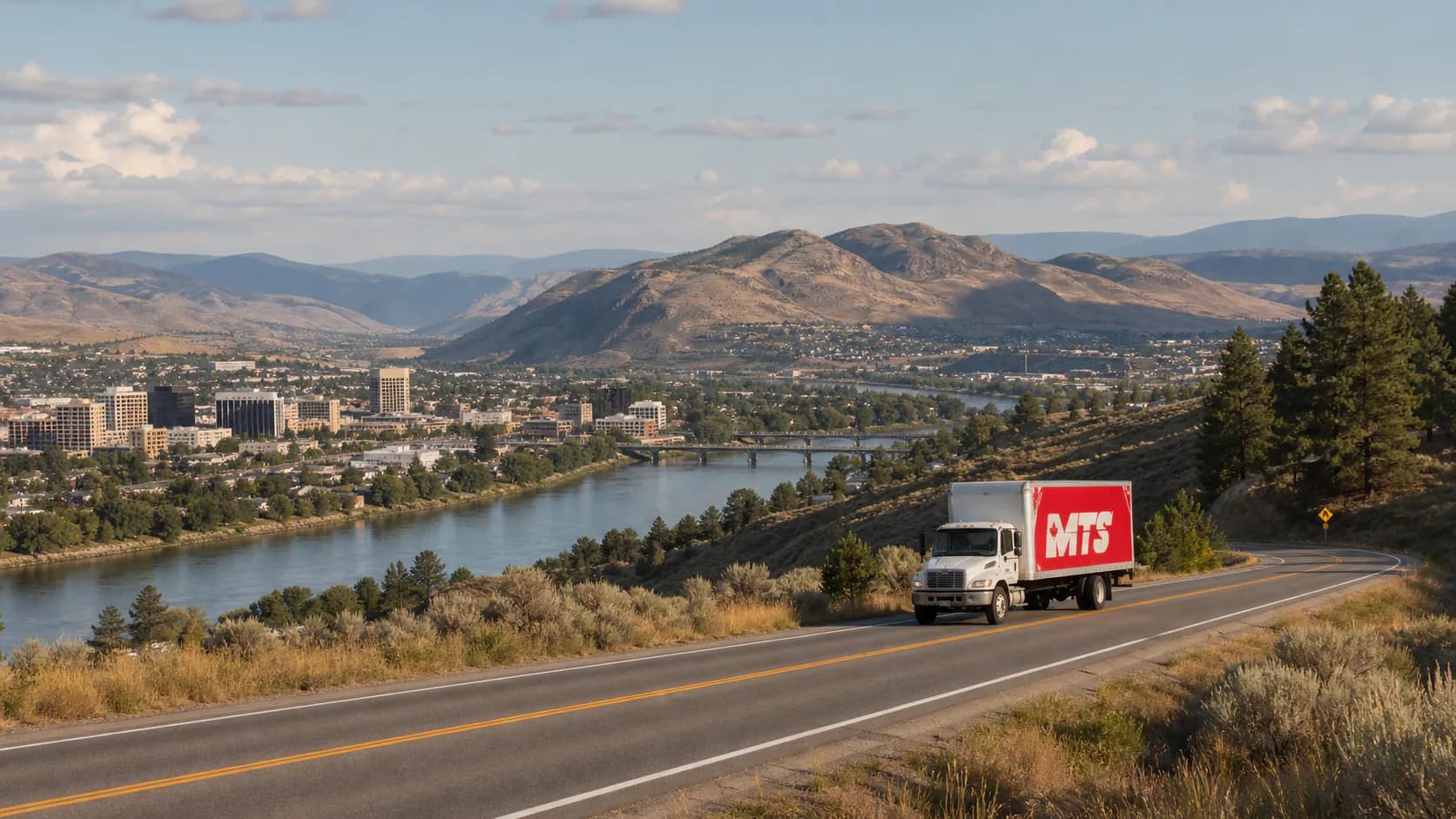
This is where a lifestyle guide usually stops — but the mechanics of getting your household here are their own project. At MTS we run the western corridors regularly, and a few Kamloops-specific realities come up on nearly every move.
Most Kamloops moves originate from the Lower Mainland or Alberta. From the coast, the practical route is the Coquihalla (Highway 5) — a high mountain pass that is straightforward in summer and demanding from roughly November to March. Winter chain-up requirements and sudden closures are normal, so we watch DriveBC conditions and build schedule slack rather than promising a delivery hour we can’t control. Alberta-origin moves come over Highway 1 through the interior with their own winter passes.
Hillside delivery takes planning. Sahali, Aberdeen, Juniper Ridge, and Sun Rivers sit on steep grades with narrow, curving streets. A full-size trailer can’t always get to the door, so we scout access ahead of time and shuttle with a smaller truck where needed. Flagging your street’s grade and turning room when you request a quote saves surprises on the day.
Summer means heat and smoke. July and August bring both high heat and wildfire-smoke advisories. For summer moves we load early in the day to protect the crew and your belongings, and we stay flexible when air quality deteriorates.
Timing gaps are common. Selling a Lower Mainland home and taking possession in Kamloops rarely lines up to the day. Storage-in-transit — where we hold your shipment securely between pickup and delivery — bridges that gap without a second move.
If it helps to talk it through, MTS is a second-generation long-distance mover based in Mississauga, running interprovincial corridors across Ontario, Alberta, BC, and Quebec, with a 4.9-star rating from 741 Google reviews. Our own trained crews handle packing, loading, transport, and storage — no subcontractors — and shipments are weighed on government-certified scales so pricing is transparent, not a guess.
Conclusion: what is Kamloops really known for?
Kamloops is known for affordability, year-round outdoor adventure, and a welcoming, family-friendly community — balanced against limited big-city amenities, stretched healthcare, and smoky summers. If you want space to grow and easy access to nature without Vancouver prices, it’s worth a serious look.
FAQs on what Kamloops is known for
Is Kamloops a good place to live?
Yes, for the right priorities. Kamloops is one of BC’s more livable mid-sized cities, combining affordability, access to nature, and a family-friendly feel. It lacks some big-city amenities and healthcare capacity is tight, but most residents rate their quality of life highly thanks to the climate, outdoors, and community.
Why is Kamloops called the Tournament Capital?
Kamloops hosts more than 100 tournaments a year across hockey, baseball, basketball, swimming, and other sports. With strong facilities and a youth-sport culture, it holds the nickname “Tournament Capital of Canada.”
Is Kamloops more affordable than Kelowna?
Yes. The single-family benchmark is roughly 35% lower than Kelowna’s, and rents run about 20% lower. Groceries, utilities, childcare, and transportation are cheaper too, which is why it draws families, retirees, and students.
What is winter like in Kamloops?
Colder than Vancouver or Kelowna but far sunnier. Expect January highs near -1 °C and lows around -6 to -9 °C. The city gets much less snow than the Rockies, and clear skies make it one of Canada’s brightest winter destinations. On the roads in, the Coquihalla pass can require chains and close on short notice.
What is Kamloops famous for outdoors?
It’s the “Outdoor Adventure Capital of BC” — hiking, biking, skiing at Sun Peaks, golfing, and water sports on over 100 nearby lakes. The dry, four-season climate means there’s something to do outside nearly every month.
Related guides

The newcomer’s guide to long-distance moving to Vancouver
What a long-distance move to Vancouver really costs — corridor price ranges, cost of living, neighbourhoods, transit and moving-day tips from a mover.
Learn more
Is Kelowna a good place to live?
Moving to Kelowna? A mover's honest guide to 2026 cost of living, neighbourhoods, jobs, transit and lake lifestyle — plus the trade-offs to plan for.
Learn more
5 reasons not to move to Kelowna
Thinking about Kelowna? Here are five honest reasons to think twice — housing costs, wildfire smoke, drought, traffic and a thin job market — before you move.
Learn more
Moving to Surrey
Moving to Surrey, BC? A long-distance mover breaks down 2026 home prices, rent, neighbourhoods, commutes and the real downsides before you relocate.
Learn more
Moving to Richmond, BC
Moving to Richmond, B.C.? Real 2025 housing and rent numbers vs Vancouver, best neighbourhoods, transit, schools and long-distance move tips from MTS.
Learn more
Director, MTS Moving
Mete Kalfa is the Director of MTS Moving and a second-generation long-distance relocation expert. Specializing in inter-provincial moves across Ontario, Alberta, and British Columbia, he leverages decades of family legacy and active Canadian Association of Movers (CAM) membership to provide transparent insights that protect consumers from industry scams.