
What to Look for in Cross-Province Movers (And How to Avoid Getting Burned)

Published Updated 9 min read
On this page
- Why choosing the right cross-province mover matters
- In this guide
- What are the 5 must-haves of a trustworthy cross-province mover?
- 1. A written, itemized quote based on a real weight estimate
- 2. Coverage that goes beyond the legal minimum
- 3. Certification and a verifiable track record
- 4. In-house crews, not subcontractors or rail transfers
- 5. A physical address, real contact, and delivery windows you can plan around
- What are the top red flags to walk away from
- How the weigh-scale process should actually work
- FAQs: cross-province moving
Quick answer: Vet a cross-province mover on five things: a written, itemized quote based on a real weight estimate; coverage above the $0.60/lb legal minimum; certification with the Canadian Association of Movers (CAM); in-house crews rather than subcontracted or rail transfers; and a verifiable physical address with real reviews. Walk away from phone-only estimates, large upfront deposits, and any mover that won’t put the price in writing.
I’m Mete Kalfa, director of MTS Moving. I’m a second-generation long-distance mover based in Mississauga, Ontario, and I’ve spent my career running interprovincial jobs across Ontario, Alberta, British Columbia, and Quebec. This guide is the vetting process I’d give my own family if they were hiring a mover I didn’t already know.
Here’s the uncomfortable part of my industry: the Canadian moving business has been effectively unregulated since the mid-1980s, so nothing stops a bad operator from printing a website and calling themselves a “national” mover (Canadian Association of Movers). That’s why knowing what to look for matters more than the sticker price.
Why choosing the right cross-province mover matters
When your shipment leaves Toronto for Calgary, it’s on the road for days and out of your sight the entire time. That gap is exactly where rogue operators do their damage.
The classic scam works like this: you get a low quote, the crew loads your home, and once your belongings are on the truck the price jumps, sometimes by hundreds of percent, based on a “reweigh” you never see. If you don’t pay, they hold the load. A CBC Marketplace investigation documented crews inflating quotes by 300 to 500 percent mid-move and threatening to dispose of customers’ belongings; the follow-up investigation led to more than 800 criminal charges against the operators behind a group of national moving brands.
This is a “hostage load,” and it is not rare. The good news is that every one of these operators fails at least one of the checks below before they ever touch your furniture. You just have to run the checks.
In this guide
- The 5 must-haves of a trustworthy cross-province mover
- The top red flags to walk away from
- How the government weigh-scale process should work
- What a cross-province move actually costs
What are the 5 must-haves of a trustworthy cross-province mover?
When you’re handing a stranger everything you own, “good enough” isn’t good enough. These are the five non-negotiables, and what each one looks like when it’s done right.
1. A written, itemized quote based on a real weight estimate
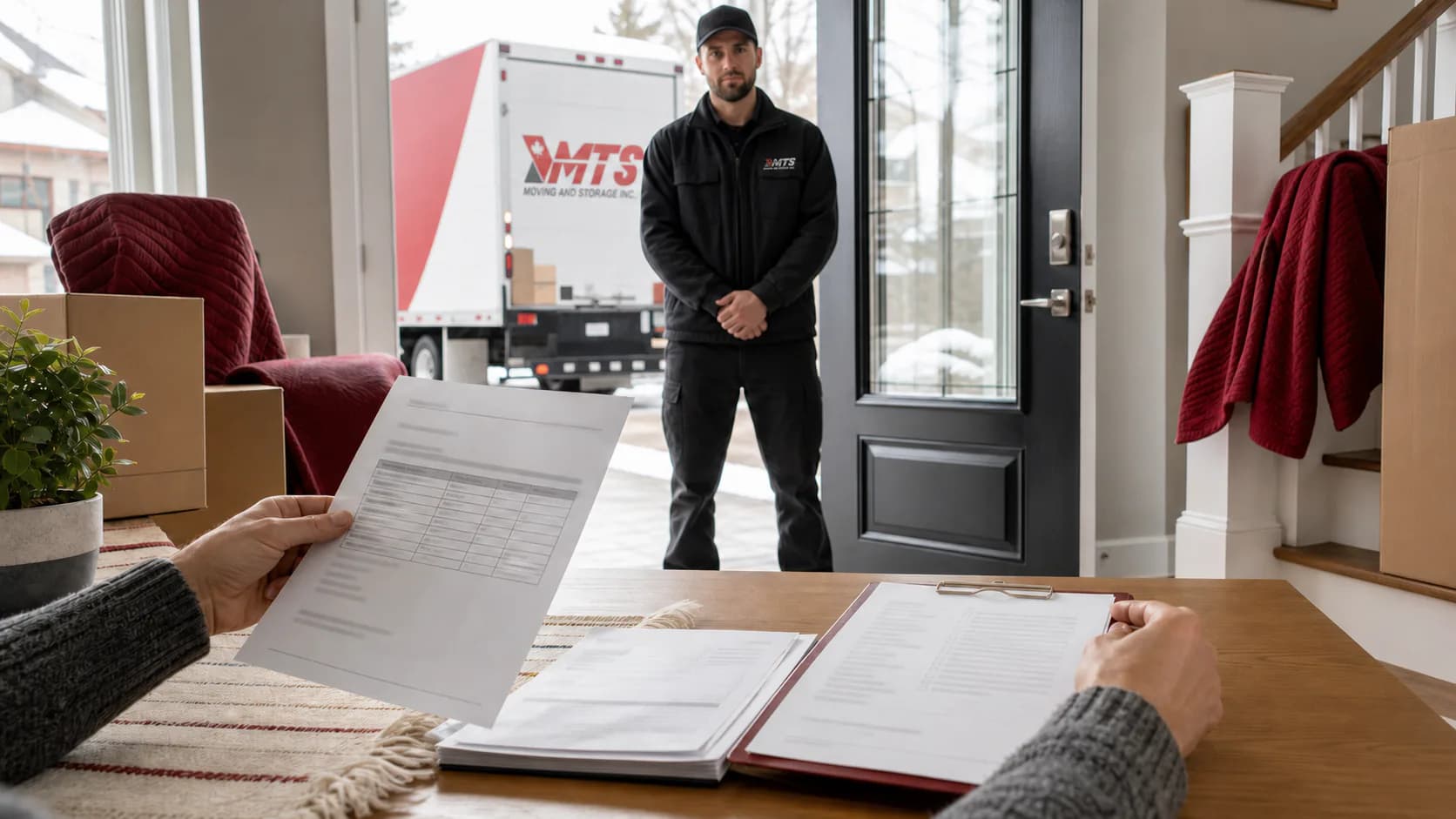
Interprovincial moves are priced by weight, so the quote is only as honest as the weight estimate behind it. The Government of Canada’s Office of Consumer Affairs advises getting your quote “on a company letterhead and signed by a company representative,” and making sure the mover has actually seen everything that needs to move before quoting.
A real quote spells out fuel, stair and long-carry charges, elevator time, coverage, and tax. If any of that is missing, it isn’t a quote, it’s bait. At MTS we build the quote from a video or in-home inventory, and the weight is verified on a certified scale (more on that below) rather than guessed at on delivery day. Get every mover to itemize the same way so you’re comparing like for like.
2. Coverage that goes beyond the legal minimum
This is the check most people skip, and it’s the one that costs them. Under default “released value” protection, a Canadian mover’s liability is capped at $0.60 per pound per article (Government of Canada). That means a 40-lb TV destroyed in transit pays out $24, not its replacement cost.
The Canadian Association of Movers is blunt that released value “is generally not adequate.” For a cross-province move, ask about replacement (declared) value coverage instead, which insures your shipment closer to what it would actually cost to replace. At MTS we carry protection above the $0.60/lb floor and walk clients through full replacement-value options for high-value items before the truck loads, so nobody discovers the gap after something breaks.
- Roughly what it pays
- $0.60 / lb per article
- Good for
- Almost nothing on a real move
- Roughly what it pays
- Replacement cost, minus deductible
- Good for
- Cross-province household moves
3. Certification and a verifiable track record
Because the industry is unregulated, third-party credentials do the vetting that the government doesn’t. The Office of Consumer Affairs specifically tells consumers to “find out if the mover is certified by the Canadian Association of Movers (CAM)” and to be wary of any company not listed by CAM or the Better Business Bureau.
CAM members sign a Code of Ethics and follow Canada’s Good Practice Guidelines for movers, which gives you recourse a fly-by-night operator can’t offer. MTS is an active CAM member, and our reputation is public and checkable: 4.9 stars from 741 Google reviews, plus listings on Yelp, HomeStars, and the BBB in Mississauga. Read the one- and two-star reviews too; that’s where a mover’s real behaviour under pressure shows up.
4. In-house crews, not subcontractors or rail transfers
Every hand-off is a chance for something to get damaged, delayed, or lost, and it’s where accountability disappears. When a “mover” is really a broker who subcontracts your load, or transfers it to rail partway, no single company owns the outcome.
Ask directly: Will the crew that loads my home be your employees, and does my shipment stay on one truck the whole way? At MTS the answer is yes, we use trained full-time crews from pickup to delivery, no temps, no third-party carriers, no rail transfers. If a mover can’t give you a clear yes, treat the vague answer as the answer.
5. A physical address, real contact, and delivery windows you can plan around
Rogue operators rarely have a real office and rarely show up in person to estimate. The government’s red-flag list leads with movers who have no physical address and who quote over the phone instead of in writing.
A legitimate cross-province mover gives you a realistic delivery window (not a fantasy “48-hour” cross-country guarantee), a way to reach dispatch, and ideally direct contact with your driver so you’re never wondering where your life is. Verify the address exists. Verify the phone is answered by a human. These take five minutes and screen out most bad actors.
What are the top red flags to walk away from
If you see any of these, stop and get another quote:
- Phone- or email-only estimates. No one who quotes your whole home sight-unseen intends to honour that number.
- A price that’s well below every other bid. Lowball now, “reweigh” surcharge later. This is the single most common pattern in documented scams.
- A large deposit demand. A mover can legally ask for payment before delivery, but per the Office of Consumer Affairs that payment usually shouldn’t exceed the estimate by more than 10 percent. A big upfront deposit is a warning sign.
- No written contract, or fuzzy terms. Vague delivery windows, vague coverage, and vague fees are how the final bill balloons.
- No physical address, or a company that keeps changing names. Both make it impossible to hold anyone accountable.
- Pressure to sign fast, then silence after booking. Combined with a deposit already paid, this is the setup for a hostage load.
For the full picture on where the money leaks, see our guides on avoiding hidden moving fees and spotting long-distance moving scams in Canada.
How the weigh-scale process should actually work
Since weight sets the price, the scale is where honest and dishonest movers separate. Here’s how a transparent weigh should run, so you know what you’re entitled to ask for.
A legitimate interprovincial move is weighed twice on a certified public scale: the truck is weighed empty (the “tare” weight) and again loaded, and the difference is your shipment’s billable weight. You are entitled to see both tickets. A rogue operator skips this, quotes a “we’ll weigh it later” number, and reports whatever weight justifies the surcharge they always intended to charge.
On our long-distance jobs we’ve made this verifiable rather than something you have to take on faith: we’ll do a video call with the customer at the government scale so you watch the tare and loaded weights come in live. It’s a simple step, and it removes the exact information gap that reweigh scams depend on. If a mover won’t show you the scale, that tells you what the scale would have shown.
For how weight, distance, and season combine into the final number, our pillar guide breaks down long-distance moving costs in Canada.
FAQs: cross-province moving
Q: What’s the best way to move between provinces? A: For most households, a reputable full-service interprovincial mover is the safest and least stressful option. Prioritize in-house crews, a written, itemized quote, CAM certification, and coverage above the legal minimum, over the lowest number on the page.
Q: How do I know if a moving company is legit? A: Confirm a physical address, check that it’s certified by the Canadian Association of Movers or listed with the BBB, read its Google reviews (including the bad ones), and insist on a detailed written quote. Never accept a phone-only estimate.
Q: How much does a cross-province move cost? A: It depends on shipment weight, distance, and services, but a full-service move across Canada generally runs about $4,000 to $12,000, with route and home size driving the spread (HomeStars 2026 guide). A quote far below that range usually signals a lowball weight estimate or hidden fees.
Q: What coverage do movers actually provide? A: By default, only “released value” protection of $0.60 per pound per article, which the Government of Canada notes is minimal. For a cross-province move, ask about replacement (declared) value coverage so a damaged item is reimbursed near its real cost.
Q: How large a deposit is normal? A: A mover can ask for payment before delivery, but it typically shouldn’t exceed the estimate by more than 10 percent (Office of Consumer Affairs). A demand for a large upfront deposit is a red flag.
Vetting a mover is really just avoiding the common long-distance moving mistakes before they cost you. Run the five checks, and if you’d like a mover that already passes them, our interprovincial movers are happy to be one of the quotes you compare.
Related guides

Long-distance moving costs in Canada: the full breakdown
What it costs to move across Canada in 2026, by home size and by route (Toronto–Calgary, Toronto–Vancouver), plus the hidden fees to check before you book.
Learn more
How to avoid hidden fees when moving
Long carry, shuttle, stair and fuel charges quietly inflate a move. Here is what each one costs and exactly how to keep them out of your final invoice.
Learn more
Avoiding long-distance moving scams in Canada
How to spot and avoid long-distance moving scams in Canada: the 7 most common cons, the red flags, and the CAM- and government-backed checks that protect you.
Learn more
The best long-distance movers: how to compare them
How to choose the best long-distance movers in Canada — CAM membership, written quotes, full-value protection and the scam red flags to check before you book.
Learn more
Long-distance moving mistakes to avoid
The 5 costliest long-distance moving mistakes Canadians make — and how a second-generation mover avoids them. Real coverage rules, costs, and fixes.
Learn more
Director, MTS Moving
Mete Kalfa is the Director of MTS Moving and a second-generation long-distance relocation expert. Specializing in inter-provincial moves across Ontario, Alberta, and British Columbia, he leverages decades of family legacy and active Canadian Association of Movers (CAM) membership to provide transparent insights that protect consumers from industry scams.